

Age and Fertility Chances: Real Odds of Getting Pregnant at 30, 35 & 40
 By Chitra Shankar
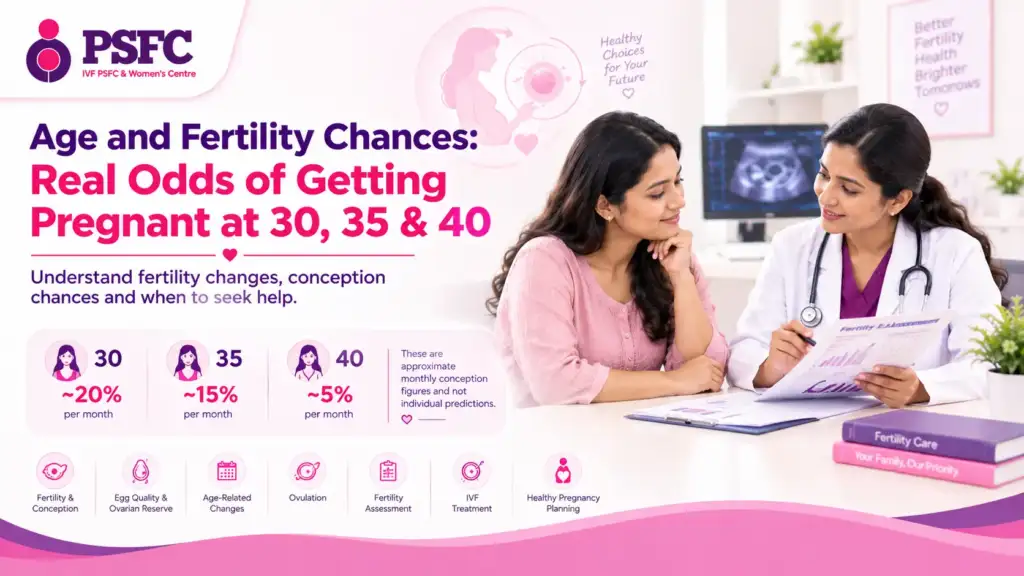
Somewhere between a friend’s offhand “you know it gets harder after 35, right?” and a chart that looks like a ski slope, most people end up more anxious than informed. If that’s how you got here, take a breath. The truth is less dramatic than the internet makes it, and it’s a lot more useful.
This guide sets out what the research says, where each number comes from, and what those numbers can and can’t tell you. We’ll also talk about what to do next, because a statistic only helps if it leads to a decision.
Age and Fertility Chances: The Short Answer
Age and fertility chances follow a slope, not a cliff. Fertility is at its best in your 20s, eases down gently through the early 30s, and falls faster from the late 30s on. By 40, the monthly chance is far lower than it was at 30. It isn’t zero, though, and plenty of people in their 40s do get pregnant.
Two things matter more than any single number. First, these figures are averages from large groups of healthy couples, so they describe a crowd, not you. Second, it’s never just one person’s age. Your partner’s age, your health and your cycles all pull on the result too.
How Age Affects Fertility
Start with the eggs, because that’s where most of the story is. You were born with every egg you’ll ever have, around a million of them. By puberty about 300,000 remain, and the count keeps dropping month after month. Nothing tops it up.
Quantity is only half of it. As eggs get older, more of them carry chromosomal errors. An egg like that might not fertilise, might not implant, or might lead to an early miscarriage. That’s why how age affects fertility shows up in two ways: it changes how long it takes to conceive, and it changes how likely a pregnancy is to continue. Flo Health’s summary of the research puts the start of a gradual decline at around 32, with a quicker drop from about 37.
It’s Not Only About Women
Men aren’t exempt. They make new sperm all their lives, but as they age the sperm tend to swim less well and more of them have an unusual shape. YourFertility, an Australian fertility education program, notes that partners of men over 40 take longer to conceive, and that the two partners’ ages work together. If you’re trying as a couple, look at both ages, not just hers.
Chances of Getting Pregnant by Age: Per Month and Per Year
Here’s where most charts trip people up. They mix two very different questions. One is “what are the odds this month?” The other is “what are the odds I’ll get pregnant at some point in the next year?” A 20% monthly chance and a 65% yearly chance can describe the very same person, which is why the chances of getting pregnant by age look so confusing when they’re lumped together.
Chance of pregnancy in a single month (healthy women, approximate, from CCRM):
| Age | Chance per month |
| 20 | about 25% |
| 30 | about 20% |
| 35 | about 15% |
| 40 | about 5% |
Chance of conceiving within 12 months of trying (approximate ranges, from MedicineNet):
| Age group | Chance within a year |
| 20–24 | 85–90% |
| 25–29 | 75–85% |
| 30–34 | 60–70% |
| 35–39 | 40–50% |
| 40–44 | 20–30% |
Read these natural pregnancy chances by age as rough ranges, not promises. They come from different studies, so don’t compare a number in one table with a number in the other. Other studies report somewhat different yearly figures too, depending on who was studied and how often couples had sex during the fertile window.
Here’s another way to see the same thing. YourFertility summarises a study that compared women with those aged 30–31. The chance of conceiving was 14% lower at 34–35, 19% lower at 36–37, 30% lower at 38–39, and 53% lower at 40–41. Those are steady steps, each a little bigger than the last. There’s no ledge waiting for you on your 35th birthday.
Getting Pregnant at 30: Still Close to Your Peak
For most women, getting pregnant at 30 sits near the top of the curve. A monthly chance of about one in five still means it can take a few cycles, and for some healthy couples a full year. If month two or three ends with a negative test, that says nothing about your fertility. It’s just how the odds work.
What matters more at this age is what’s going on underneath, not your birthday. Very irregular cycles, PCOS, thyroid problems, endometriosis and weight can all affect ovulation, and none of them wait until 35 to appear. If your periods are irregular or missing, get checked early instead of spending a year guessing.
Thirty is also a good age to think ahead if you want more than one child. Starting now leaves room for a second baby before the steeper part of the curve.
Getting Pregnant at 35: What Actually Changes
Thirty-five gets a lot of drama, but what changes is mostly the timeline. The monthly chance is around 15%, and the advice on when to ask for help gets shorter (we’ll come to that below). You may hear the phrase “advanced maternal age” at this point. It’s a label doctors use to trigger closer monitoring, not a verdict on your chances.
Getting pregnant at 35 is very possible, and many people manage it without any help. But because each month counts a little more, information becomes more valuable. A basic assessment can show your ovarian reserve, which is roughly how many eggs you have left, and whether anything else is in the way. You can see what that involves on our fertility assessment page.
Not ready to try yet? Egg freezing is worth understanding. Frozen eggs keep the age they were when they were frozen, and that’s the whole point. Our fertility preservation page explains how it works.
Getting Pregnant at 40: What to Realistically Expect
Let’s be straightforward about getting pregnant at 40. The monthly chance is about 5%, and the chance of conceiving within a year of trying is roughly 20–30%. Egg quality is the main limit, because a larger share of eggs carry chromosomal errors.
That doesn’t mean it can’t happen. People conceive naturally at 40 and beyond, and many more get there with treatment. What changes is the pace. At 40, waiting several months to see what happens costs more than it did at 30, so most fertility specialists suggest getting checked early instead of trying alone for a long time.
If you’re reading this at 40 with a knot of hope and dread in your stomach, you’re in good company. The numbers are real. So are the options, and the sections below cover what those can and can’t do.
Miscarriage Risk by Age: What the Research Shows
This is the hardest part of the topic, so let’s take it gently. Miscarriage risk by age is real, but miscarriage is common at every age. In a large Norwegian study of more than 420,000 pregnancies, published in the BMJ in 2019, about 13% ended in miscarriage. The lowest risk was at 25–29, at 10%. It rose quickly after 30 and reached 53% at 45 and over.
An older Danish study of over a million pregnancies saw the same shape. More than one in five pregnancies in 35-year-olds didn’t continue to birth, counting miscarriage, ectopic pregnancy and stillbirth together. At 42, the risk of miscarriage was around half.
The usual reason is those chromosomal errors in eggs. They happen at random, and they aren’t something anyone causes. Past losses matter too. The Norwegian study found the risk was about 50% higher after one miscarriage, double after two, and four times higher after three in a row. If that sounds like your history, our guide to recurrent pregnancy loss covers the causes and tests.
And if you’ve had a loss, please hear this: it doesn’t mean you waited too long or did something wrong.
IVF Success by Age: What It Can and Can’t Change
People often think of IVF as a way around age. It isn’t, quite. When you use your own eggs, IVF success by age follows the same slope as natural conception, because the eggs are the same age you are. What IVF can do is help with fertilisation, choose the healthiest embryo, and work around blocked tubes or sperm problems.
The UK’s fertility regulator, the HFEA, reports live birth rates per embryo transferred using a patient’s own eggs. These figures are from 2018, and they’re among the most complete national numbers available:
| Age group | Live birth per embryo transferred (own eggs) |
| Under 35 | 31% |
| 35–37 | 25% |
| 38–39 | 19% |
| 40–42 | 11% |
| 43 and over | below 5% |
The same report found that donor eggs lift the chance to above 20% on average, even for older patients, because the eggs come from a younger donor. Our guide to donor-assisted fertility explains how that works.
One caution when you compare numbers. Clinics report success in different ways: per embryo transferred, per cycle started, or added up over several cycles. The same result can look very different depending on the measure. When you ask any clinic for its figures, ask which measure it uses and for which age group. To talk through your own case, you can visit our IVF centre page.
When to See a Fertility Specialist: Don’t Wait Longer Than You Need To
Knowing when to see a fertility specialist may be the most practical thing you take from this guide. The usual rule, used by ASRM and quoted by several health sites, depends on your age:
- Under 35: after 12 months of trying without success.
- 35 or older: after 6 months.
- At 40 and above: many specialists advise not waiting the full six months and getting checked right at the start.
Go sooner, at any age, if you have very irregular or absent periods, known PCOS, endometriosis or fibroids, a history of pelvic infection or surgery, two or more miscarriages, or a partner with a known sperm problem.
A first visit is usually less daunting than people expect. It typically includes a chat about your history, a blood test such as AMH to estimate your ovarian reserve, an ultrasound to count the small follicles, and a semen analysis for your partner. Testing both of you from the start saves time. If you’d like to book, you can contact our care team.
Frequently Asked Questions
1. What is the best age to get pregnant?
Biologically, the 20s. But the best age is personal, and plenty of healthy pregnancies happen in the 30s and beyond. The more useful question is how much time you want to keep in hand.
2. Is 35 really a fertility cliff?
No. Fertility declines gradually and faster from the late 30s, which is why 35 is used as a checkpoint. It isn’t a sudden switch.
3. At what age does a woman lose 90% of her eggs?.
A woman’s egg reserve declines with age, with a significant reduction often occurring by the early 30s and becoming more pronounced after 35. By around age 37, many women have lost roughly 90% of the eggs they had at birth.
4. Is it possible to get pregnant at 45 years old?
Yes, pregnancy at 45 is possible, but natural conception becomes less likely due to declining egg quantity and quality. Fertility treatments such as IVF may offer options. A fertility specialist can assess your individual chances and recommend suitable treatment.
5. Can egg freezing help?
It can, if it’s done before egg quality drops steeply, because frozen eggs keep the age they had when they were frozen. It doesn’t guarantee a pregnancy, but it can widen your options.
