
Introduction: The Future of Fertility Is Already Here
Artificial Intelligence (AI) is revolutionising industries across the globe — and reproductive medicine is no exception. In IVF laboratories worldwide, AI tools are now helping embryologists select the best embryos, predict outcomes, and personalise treatment protocols with a level of precision that was not possible just a decade ago.
At PSFC OMR, Chennai, we stay at the forefront of reproductive technology to give our patients the best possible outcomes. Here’s how AI is transforming IVF.
The Challenge AI Is Solving: Embryo Selection
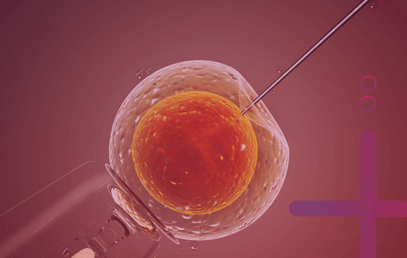
Selecting the right embryo for transfer has historically been one of the most subjective decisions in IVF. Embryologists evaluate embryos using standardised grading systems — but these assessments are visual and can vary between observers. Not all top-graded embryos implant, and some lower-graded embryos do.
AI changes this equation by analysing thousands of data points that the human eye cannot reliably detect.
How AI Is Being Used in IVF Today
1. AI-Powered Embryo Grading
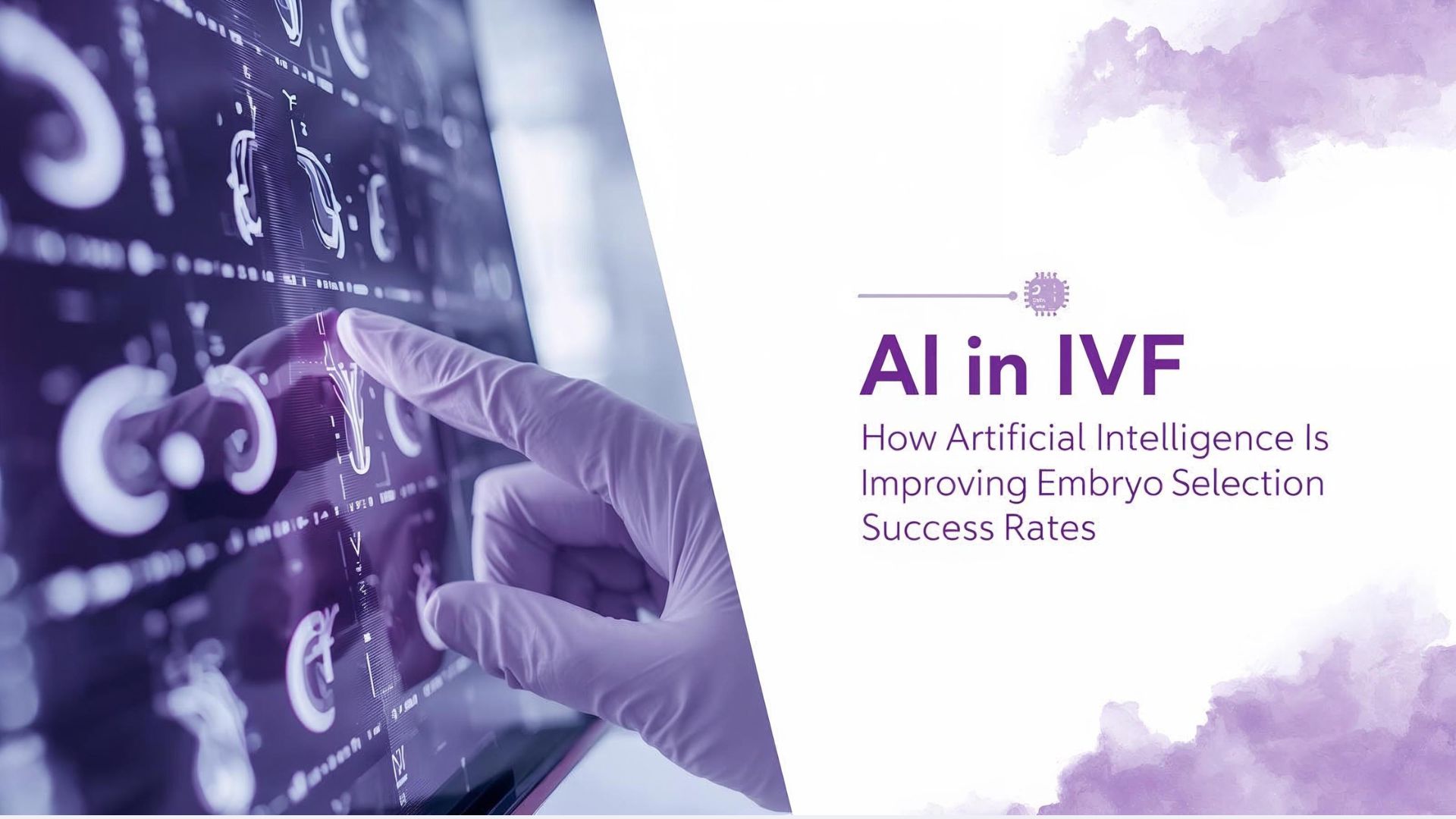
AI algorithms — trained on hundreds of thousands of embryo images and their clinical outcomes — can analyse embryo morphology at a cellular level with unmatched consistency. Tools like iDAScore and EEVA Time-Lapse System continuously monitor embryo development and generate objective viability scores.
2. Time-Lapse Imaging + AI Analysis
Time-lapse incubators capture embryo development images every 5–20 minutes without removing embryos from the stable incubator environment. AI analyses these images to identify developmental patterns correlated with higher implantation rates.
3. Predicting IVF Success
AI platforms can integrate patient-specific variables — age, AMH, sperm parameters, hormonal profile, and previous IVF history — to predict individualised IVF success rates and optimise stimulation protocols before a cycle begins.
4. Sperm Selection with AI
AI-assisted sperm selection tools, like FERTILE software or AI-IMSI, analyse sperm morphology and motility at a level beyond human visual capability, helping select the best sperm for ICSI.
5. Personalising Stimulation Protocols
Machine learning models can analyse large patient datasets to recommend optimal FSH doses and stimulation protocols, reducing ovarian hyperstimulation syndrome (OHSS) risk while maximising egg yield.
AI Embryo Selection vs. Traditional Grading
| Feature | Traditional Grading | AI-Assisted Grading |
| Assessment basis | Visual morphology (observer-dependent) | Thousands of morphological + kinetic data points |
| Consistency | Varies between embryologists | Highly consistent across assessments |
| Time-lapse integration | Limited | Continuous developmental monitoring |
| Outcome prediction | Based on day-5 morphology alone | Predictive modelling using full development history |
| Error margin | Higher (subjectivity) | Lower (data-driven) |
What Does AI Mean for IVF Success Rates?
Early studies and real-world clinical data show promising results. AI-assisted embryo selection has been associated with:
- 10–15% improvement in implantation rates in some studies
- Reduced need for multiple embryo transfers
- Better outcomes in patients with previously unexplained IVF failures
It’s important to note that AI is a decision-support tool — the final clinical decision always rests with the experienced embryologist and fertility specialist.
The Role of the Embryologist in the Age of AI
AI does not replace the embryologist — it empowers them. The best outcomes come when AI analysis is combined with clinical expertise, patient history, and the embryologist’s experience. Think of AI as a second expert opinion that never tires and never has a bad day.
AI & IVF at PSFC OMR, Chennai
Our laboratory is equipped with time-lapse monitoring systems and advanced embryo evaluation technologies. Our embryologists use these tools in combination with their clinical expertise to give every embryo — and every patient — the best possible assessment.
Conclusion
AI in IVF is not science fiction — it is clinical reality. By combining the precision of machine learning with the wisdom of experienced specialists, we are entering an era of smarter, more personalised, and more successful fertility treatment.
The goal of AI in IVF isn’t to replace the human heart in medicine — it’s to make the science more precise so more families can come home with their miracle.
FAQs
Does AI guarantee IVF success?
No. AI improves the accuracy of embryo selection and protocol personalisation, but IVF outcomes are influenced by many biological factors. AI is a powerful tool, not a guarantee.