


Medical review: Have this article medically reviewed and approved by Dr. Chitra Shankar MD (OG), MRCOG, DRM (Germany), FMAS, before publication.
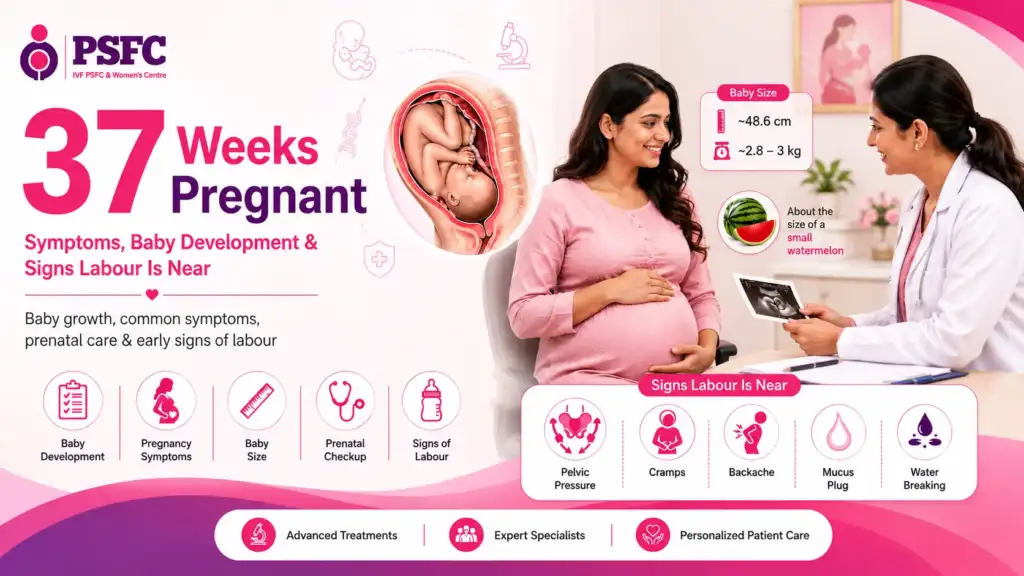
| At 37 weeks pregnant, you’re in early term your baby weighs around 2.9 –3.3 kg and is about the size of a small watermelon. Most organs, including the lungs and brain, are ready to function independently. Common symptoms include pelvic pressure, Braxton Hicks contractions, and lower back ache. Real labour signs include your water breaking, a bloody show, or contractions 5 minutes apart lasting an hour. Call your doctor immediately for heavy bleeding, reduced baby movement, or water breaking. |
How Big Is Your Baby at 37 Weeks?
| Measurement | Approximate Value |
| Length (crown to heel) | ~48–49 cm (19 inches) |
| Weight | ~2.9–3.3 kg (6.4–7.3 lbs) |
| Comparable size | A stalk of Swiss chard / small watermelon |
| Development stage | Early term |
Your baby continues gaining roughly 15–30 grams a day this week that’s the fat layer that will help them regulate their own body temperature once they’re born. If your baby feels “big” or “small” compared to a friend’s pregnancy at the same stage, that’s usually completely normal; your doctor tracks growth against your own baby’s pattern, not a single average.
What’s Happening With Your Baby This Week
- Lungs and breathing muscles are practicing steady “breathing” motions with amniotic fluid, getting ready for that first real breath.
- The grasp reflex is strong now babies born at this stage often grip a finger firmly.
- Lanugo (the fine body hair from earlier pregnancy) is shedding, while the hair on baby’s head keeps growing.
- Many babies settle head-down by now, though it isn’t guaranteed yet especially in first pregnancies, where engagement can happen later or even during labour itself.
- Baby’s immune system is getting a boost through antibodies passed from you, which will offer some protection in the first months after birth.
What’s Happening With Your Body
Physically and emotionally, 37 weeks can feel like a lot at once:
- Increased pelvic pressure as baby settles lower sometimes described as a “bowling ball” feeling
- More frequent Braxton Hicks contractions (irregular, usually painless tightening)
- Lower back ache, especially by evening
- Trouble sleeping between bump size, frequent bathroom trips, and racing thoughts about labour, this is one of the most common complaints at this stage
- Mild swelling in feet and ankles (sudden or severe swelling needs prompt attention see the red-flag list below)
- Increased vaginal discharge
- Mood swings or anxiety about labour completely normal, and worth mentioning to your doctor or midwife if it’s affecting your day-to-day wellbeing
A note on how you’re feeling, not just your symptoms
It’s common to feel done with being pregnant by this point, and equally common to feel unready for what comes next both at once. If anxiety, low mood, or racing thoughts are keeping you up at night beyond the usual physical discomfort, mention it at your next appointment. Your care team can support your mental wellbeing just as much as your physical health in these final weeks.
Eating, Moving & Resting This Week
- Small, frequent meals can help if a full stomach feels uncomfortable with baby pressing upward.
- Keep up fluids dehydration can sometimes trigger Braxton Hicks contractions to feel more intense.
- Gentle walking or prenatal stretches can ease back discomfort, but check with your doctor before starting anything new this late in pregnancy.
- Rest when your body asks for it “nesting” energy is common, but this isn’t the week to push through exhaustion.
Real Labour vs. Braxton Hicks — How to Tell the Difference
| Sign | Braxton Hicks | Real Labour |
| Pattern | Irregular, doesn’t get closer together | Regular, gradually closer together |
| Intensity | Stays the same or fades | Gets progressively stronger |
| Effect of movement/rest | Often eases with a position change | Continues regardless of position |
| Location | Mainly front of belly | Often starts in back, wraps to front |
Early signs labour may be approaching:
- Loss of the mucus plug (thick discharge, sometimes streaked with blood the “bloody show”)
- Your water breaking (a gush or slow trickle of fluid)
- Contractions that are regular and intensifying the “5-1-1 rule” is a helpful guide: every 5 minutes, lasting 1 minute, for 1 hour
- Persistent lower back pain paired with pelvic pressure
Keep in mind: labour doesn’t always start the way it does in movies. For many women it begins gradually, with mild cramping that slowly builds over hours not a dramatic single moment.
When to Call Your Doctor Immediately
Contact your OB-GYN or head to the hospital right away if you notice:
- Heavy bleeding (more than light spotting)
- Your water breaking, regardless of whether contractions have started
- Contractions 5 minutes apart or closer, lasting about a minute, for a full hour
- A noticeable decrease in baby’s movements
- Severe or sudden swelling in your face, hands, or feet, especially with a headache or vision changes (possible signs of preeclampsia)
- Fever, chills, or feeling generally unwell.
Getting Ready: Hospital Bag & Logistics
For you
- ID, insurance/medical documents, and your pregnancy file or reports
- Comfortable nightwear, a robe, and non-slip slippers
- Toiletries, nursing bras, and maternity pads
- A going-home outfit =loose and comfortable, since your body won’t look “pre-pregnancy” right away, and that’s completely normal
- Phone charger and a portable power bank
For baby
- A few newborn-size outfits, a swaddle or soft blanket, and a going-home outfit
- Diapers and wipes for the hospital stay
For your partner or support person
- Snacks and a change of clothes labour can take longer than expected
- Entertainment for a slow early-labour wait: a book, playlist, or downloaded show
Logistics
- Confirm your route to the hospital and a backup option, accounting for traffic at different times of day
- Save your care team’s number, including after-hours contact, somewhere you can find it quickly
- Talk through your birth plan preferences with your partner so they can advocate for you if needed
Frequently Asked Questions
Is 37 weeks considered full term?
No. 37 weeks is classified as early term. Full term is generally 39 – 40 weeks, though babies born at 37 weeks are typically healthy and their major organs are ready to function independently.
What are the first signs of labour at 37 weeks?
The most common early signs are losing the mucus plug, your water breaking, and contractions that are regular and gradually getting stronger and closer together.
Is it normal to have contractions at 37 weeks?
Yes, irregular Braxton Hicks contractions are common. Regular, intensifying contractions, however, may indicate labour is starting and should be reported to your doctor.
How many months is 37 weeks pregnant?
37 weeks is about 8 months and 5 days.
Can baby be delivered safely at 37 weeks?
Babies born at 37 weeks are considered early term and generally do well, though your doctor may recommend waiting if there’s no medical reason to deliver earlier, since a few more weeks allow further brain and lung maturation.
Is it normal to feel anxious or overwhelmed this close to labour?
Yes a mix of excitement and anxiety is very common in the final weeks. If it’s affecting your sleep or daily life beyond typical pre-labour nerves, mention it to your doctor; support is available.
What if I go past my due date?
Many first-time pregnancies go slightly past the due date, and this is usually not a cause for alarm. Your doctor will monitor you closely and discuss options like induction if your pregnancy extends well beyond 40 weeks.
Talk to PSFC’s Obstetric Care Team
If you’re experiencing any symptoms that concern you, or you’d like to talk through your birth plan, our OB-GYN team at Pearl Singapore Fertility Centre, Chennai, is here for antenatal consultations and for the reassurance that comes with having someone to ask.

