

AI Embryo Selection in IVF: How It Works, Success Rate & Cost in India
 By Chitra Shankar
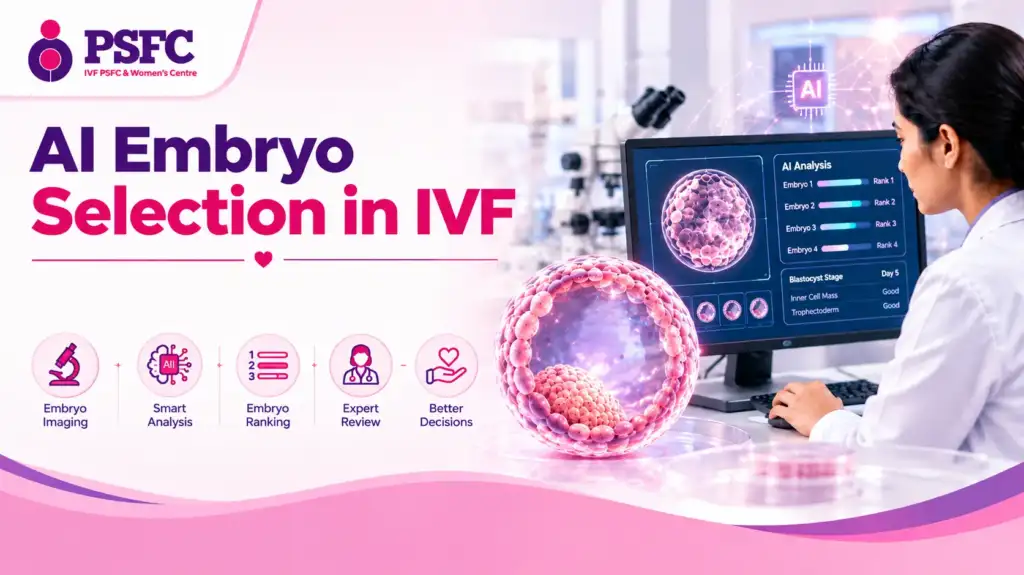
| AI embryo selection in IVF means using software, trained on thousands of embryo images, to score and rank embryos by how likely each is to lead to a pregnancy. The embryologist then uses that ranking, along with their own judgement, to choose which embryo to transfer first. In studies AI often ranks embryos well, but a randomised trial found only similar pregnancy rates to standard selection, and its effect on live births is still being tested. It is not the same as PGT-A, and it cannot guarantee a baby. |
Medical review: Have this article medically reviewed and approved by Dr. Chitra Shankar MD (OG), MRCOG, DRM (Germany), FMAS, before publication.
Your clinic mentions “AI embryo selection” in the middle of a consultation. Maybe it’s on a brochure, maybe it’s an extra line on the estimate. You nod, and then you go home and wonder: is this a real step forward, or just a shiny add-on?
Honestly, it’s a bit of both. The technology is clever, and it’s already working inside some Indian IVF labs. But it also comes wrapped in big promises that the research doesn’t always support. Let’s sort out which is which.
AI embryo selection in IVF means using software, trained on thousands of embryo images, to help rank your embryos by how likely each one is to lead to a pregnancy. It helps the embryologist. It doesn’t replace them, and it can’t promise you a baby.
In this guide you’ll find how it works, what the studies actually show, how it differs from time-lapse imaging and genetic testing, whether it’s available (and worth paying for) in India, and the questions to take to your clinic.
If you only remember five things
- AI helps rank embryos, but a human embryologist makes the final call.
- It works from images, often taken in a time-lapse incubator, so the embryo isn’t touched.
- Being good at spotting “promising-looking” embryos isn’t the same as producing more babies. That link is still being proven.
- It isn’t the same as PGT-A. PGT-A tests chromosomes, while AI judges images.
- If it costs extra, ask what evidence backs it up and what it will actually change for you.
What is AI embryo selection in IVF?
In IVF, eggs are fertilised in the lab and the embryos are grown for several days. Most couples end up with more than one, which raises an awkward question: which one should be transferred first?
AI embryo selection is a software tool that looks at photos or time-lapse videos of each embryo and produces a score or ranking, a prediction of how likely it is to implant and lead to a pregnancy. Under the hood it’s machine learning, a kind of AI that learns from examples. The tools are typically trained on many thousands of embryo images, each linked to what happened afterwards, so they pick up the visual patterns that tend to go with success.
Why is choosing the right embryo such a big deal?
Because it’s still one of the hardest problems in IVF. Even in excellent labs, nobody can look at an embryo and say for certain “this is the one”.
For decades, embryologists have judged embryos by eye. On day 3 they look at cell number and symmetry. At the blastocyst stage they look at how much the embryo has expanded and how good the inner cell mass and the outer layer (trophectoderm) look. That’s where grades like 4AA and 5BB come from. If you’d like the detail, there’s more on blastocyst grading.
It works, but it has three weak spots:
- It’s subjective. Two experienced embryologists can grade the same embryo differently, and may even put a group of embryos in a different order.
- It’s a snapshot. Embryos develop continuously, but grading checks them at fixed moments. Something important can happen between checks.
- It’s hard to weigh everything at once. Appearance, timing, the woman’s age and cycle details all matter, and combining them by eye isn’t easy.
AI was built to close exactly those gaps: to be more consistent, and to look at more information at the same time.
How does AI embryo selection work?
Think of it as four steps.
- Feed in the data. Photos of the embryo, usually at the blastocyst stage, or time-lapse videos of how it developed. Some tools also take in clinical details such as the woman’s age.
- Let the model analyse it. Most use deep learning, specifically convolutional neural networks, which are good at recognising visual patterns. Some also follow how the embryo changes over time.
- Get a score. Each embryo receives a score or rank, from lower to higher likelihood of success.
- Make the decision. The embryologist and doctor read the score alongside their own assessment, the embryo grades, any genetic results and your medical history.
One thing worth knowing: most of these models are “black boxes”. They give you an answer without explaining exactly why. That’s one reason experts keep saying the tools should support clinical judgement, not stand in for it.
Static-image AI vs time-lapse AI: what’s the difference?
You’ll hear both terms in clinics, and they’re easy to mix up. In short, one looks at a photo and the other watches a film.
| Static-image AI | Time-lapse (video) AI | |
| What it looks at | One chosen photo of the embryo, usually a blastocyst | A continuous video, or many images, of the embryo’s development |
| What it needs | A good-quality image taken at the right time | A time-lapse incubator that films the embryos |
| What it can see | Appearance: shape, cell layers, expansion | Appearance plus the timing of divisions and unusual events |
| Strengths | Simpler and cheaper to run, and works without time-lapse equipment | Captures how the embryo develops over time |
| Limits | Depends on image timing and quality, and misses the development timeline | Needs special equipment and produces huge amounts of data. A model trained on one system may not work as well on another |
What happens to your embryos in an AI-assisted IVF cycle?
Good news: nothing about your treatment changes. The AI step simply slots into the lab stage.
- Your eggs are collected and fertilised, usually by IVF or ICSI.
- The embryos grow in the lab for 5 to 6 days. In some labs this happens in a time-lapse incubator that takes pictures automatically.
- Images of each embryo go to the AI software, which scores them.
- The embryologist grades the embryos in the usual way and compares that with the AI ranking.
- Together with your doctor, they choose which embryo to transfer first and which to freeze.
The embryo itself isn’t touched. The software only analyses pictures, so handling stays exactly as it was.
Does AI embryo selection improve IVF success rates?
This is the question that matters most, and the honest answer is: we don’t know yet, and the evidence is mixed. Here’s what the research says.
| Evidence | What it found |
| Randomised trial (Nature Medicine, 2024) | A double-blind trial compared deep-learning embryo selection with standard morphology-based selection. Clinical pregnancy rates were similar, but the trial did not show that the AI approach was as good as standard selection (non-inferiority was not demonstrated). |
| Retrospective analysis of time to live birth (Human Reproduction, 2025) | Estimated a 6.1 percent shorter time to live birth when embryos were ranked by AI instead of conventional grading. It relied on statistical estimates for embryos that were never transferred, so it isn’t the same as a randomised trial. |
| Systematic review of AI vs embryologists (Human Reproduction Open, 2023) | Found that AI generally outperformed clinical teams at predicting embryo quality and outcomes in the studies reviewed. |
| Expert review (Bioengineering, 2026) | Concluded that AI has real potential, but that more validation and standard ways of using it are needed before routine use. It suggested treating AI like other IVF add-ons, which need proof of benefit. |
Put simply, AI is often good at predicting which embryos look more promising in research data. That doesn’t automatically mean more couples go home with a baby, and so far the largest trial hasn’t shown that it does. It may still help in quieter ways: making selection more consistent, saving embryologists time and possibly shortening the road to a live birth. Those are being studied.
So be wary of any clinic website that quotes a precise success or implantation rate “with AI”. Unless the number comes from a peer-reviewed study or the clinic’s own audited data, treat it as marketing.
How accurate is AI at picking the best embryo?
You’ll see some impressive percentages in headlines. It helps to know what they’re measuring.
- One widely cited study reported about 97 percent accuracy. But that was for telling high-quality blastocysts from low-quality ones, which isn’t the same as predicting a baby.
- A system built to predict whether an embryo is viable, tested on separate blinded images, reached about 70 percent sensitivity, 61 percent specificity and 64 percent overall accuracy. It did better than embryologists in that particular test.
- Models that try to predict chromosome status from time-lapse videos have reached roughly 73 percent accuracy in one study. Useful, but far from certain.
The point to hold on to is this: being accurate at predicting an outcome in a dataset isn’t the same as improving your chance of a baby. What matters is whether using the tool leads to more, or faster, live births, and that’s much harder to prove. A model that works well at the clinic where it was trained may also perform differently at another.
AI vs embryologist: who makes the final decision?
The embryologist and your doctor do. Experts are quite clear that AI should be a support tool, not an independent decision-maker, and there are good reasons for that:
- An AI score doesn’t know your whole story.
- Most tools can’t explain their reasoning, so a person needs to check that the answer makes sense.
- People can over-trust a confident-looking number. This is called automation bias.
- Responsibility for the decision stays with the clinical team.
AI isn’t taking embryologists’ jobs. If anything, a skilled embryologist using a good tool carefully is the best combination you can ask for.
AI embryo selection vs PGT-A: how are they different?
They sound similar, but they answer different questions. AI asks, “How promising does this embryo look?” PGT-A asks, “Does this embryo have the right number of chromosomes?”
| AI embryo selection | PGT-A (genetic testing) | |
| What it checks | How the embryo looks and develops, to predict its potential | Whether the embryo has the normal number of chromosomes |
| How | Software analyses images or video | A few cells are removed from the embryo (biopsy) and tested in a lab |
| Invasive? | No | Yes, it involves a biopsy |
| Can it prove chromosomes are normal? | No, it can only estimate | It gives a direct chromosome result (with its own limits) |
| Extra cost | Depends on the clinic | Usually significant |
Some clinics use both. But AI can’t replace PGT-A when you need an actual chromosome result. More on preimplantation genetic testing.
Who might benefit from AI embryo selection?
No group has been firmly proven to benefit. It may be most useful when there’s a real choice to be made:
- You have several good-quality embryos and the team has to decide which to transfer first. With only one embryo, there’s nothing to rank.
- You want a more consistent second opinion on embryo ranking, particularly in a busy lab.
- You’ve had a failed transfer and wonder whether a different ranking approach might help. Be realistic here. There’s no strong proof yet that AI solves repeated implantation failure, and other causes, such as the womb lining or chromosomes, need looking at too.
Your age, ovarian reserve, embryo numbers and history will shape your outcome far more than the choice of selection tool.
Is AI embryo selection safe?
For the embryo, yes. The software works on images, so the embryo isn’t touched, removed or exposed to anything extra. The risks sit elsewhere:
- Wrong ranking or over-reliance. The AI favours an embryo that doesn’t work out, or the team leans on it too heavily.
- Bias and generalisability. A model trained on certain patients or labs may not work as well for you.
- Data privacy. Your embryo images and clinical details are sensitive, so ask how they’re stored and used.
- Unrealistic hope. Over-selling AI can set expectations that no tool can meet.
A good clinic will explain what AI does, ask for your consent and keep a human in charge.

Learn how IVF treatment works at PSFC
Is AI embryo selection available in India?
Yes, and it’s spreading. In August 2025, a large fertility chain announced it would bring an AI embryo assessment tool to its 120 clinics across 65 cities, and the tool’s maker announced a wider partnership the following month to reach IVF labs across India. Other clinics use AI features built into time-lapse systems, or different software altogether.
What you’ll find varies a lot from clinic to clinic. Some use it on every cycle, some only if you ask, and the tools themselves differ. If a clinic says it uses AI, ask which tool, how it was validated and how it feeds into decisions (the questions are below). It’s also sensible to check that the clinic is registered under the ART (Regulation) Act, 2021 and follows its rules on embryo transfer. More on AI-assisted embryo selection.
How much does AI embryo selection cost in India?
There’s no standard price. Some clinics fold AI scoring into the IVF package, others bill it as an add-on, and it may be tied to time-lapse incubation charges. A single number would only mislead you, so here’s what moves the total:
- Whether the lab has time-lapse incubators, and whether using them costs extra
- Whether AI scoring is part of the package or a separate charge
- Other optional extras such as PGT-A, assisted hatching or embryo freezing
- The IVF-ICSI cycle itself
International guidance on IVF add-ons says extras should be offered only when there’s evidence they help, and patients should be told clearly what that evidence is. So ask for a written estimate that lists any AI or time-lapse charge separately, and ask what the extra money is expected to change. It’s also fair to ask about payment options.
Questions to ask your clinic before you pay for AI
A few good questions can tell you a lot about how seriously a clinic takes the evidence:
- Which AI tool do you use, and is it used on all embryos or only some?
- Has it been tested in published, peer-reviewed studies? Can I see them?
- Does it improve live birth rates in studies, or does it only predict embryo quality?
- How would it change which embryo you transfer in my case?
- Who makes the final decision, and what happens if the AI and the embryologist disagree?
- Does it cost extra, and how much?
- How are my embryo images and data stored and protected, and did I give consent?
- What are your own success rates, by age, with and without it?
Myths and facts about AI in IVF
| Myth | Fact |
| “AI guarantees a successful pregnancy.” | No tool can. AI helps rank embryos, but implantation depends on many other things, including chromosomes and the womb. |
| “AI picks the perfect embryo.” | It estimates likelihood, and it’s sometimes wrong. A lower-ranked embryo can still lead to a healthy baby. |
| “AI replaces the embryologist.” | Experts say it should support human judgement, not replace it. |
| “AI can tell if the embryo is genetically normal.” | It can estimate, but only genetic testing such as PGT-A directly checks chromosomes. |
| “AI can choose a boy or a girl.” | No. AI embryo selection ranks embryos by viability. In India, selecting the sex of an embryo for non-medical reasons is illegal. |
| “AI IVF makes designer babies.” | No. These tools predict embryo viability. They don’t edit or design traits. |
| “A clinic with AI always gets better results.” | Results depend on the whole programme: the lab, the doctors, your age and your history, not just one tool. |
Frequently asked questions
What is AI embryo selection in IVF?
It’s the use of software, trained on large sets of embryo images, to help rank embryos by their likelihood of leading to a pregnancy. The embryologist uses that ranking alongside their own judgement.
Does AI embryo selection guarantee pregnancy?
No. It may help choose between embryos, but implantation depends on many factors, and no selection method can guarantee a baby.
Does AI embryo selection improve IVF success rates?
The evidence is mixed. AI can rank embryos well in studies, but a randomised trial found similar pregnancy rates to standard selection without showing the AI method was as good. The benefit for live birth is still being studied.
Is AI better than an embryologist at choosing embryos?
In several studies, AI did better than clinical teams at predicting embryo quality and outcomes, but that doesn’t always turn into more live births. Experts recommend using AI as a support tool, with the embryologist making the final decision.
Is AI embryo selection the same as PGT-A?
No. AI analyses images to estimate an embryo’s potential. PGT-A takes a biopsy and tests the embryo’s chromosomes.
Can AI detect genetic or chromosome problems?
Some research models estimate chromosome status from images or videos, with moderate accuracy. They can’t replace genetic testing when you need a definite answer.
Is AI embryo selection safe for the embryo?
Yes, because it only analyses images and doesn’t touch the embryo. The main concerns are over-reliance on the score and data privacy.
Is AI embryo selection available in India?
Yes. Some clinics and chains use it, and more are adopting it. Tools and policies vary, so ask your clinic which tool it uses and how.
Does AI embryo selection cost extra?
It depends on the clinic. Some include it in the package, others charge extra, and it may be linked to time-lapse incubation costs. Ask for a written, itemised estimate.
Can AI tell the baby’s gender?
No. AI embryo selection ranks embryos by viability. Sex selection for non-medical reasons is illegal in India.
Will AI replace embryologists?
Current evidence and expert opinion say no. It’s seen as a decision-support tool, and human oversight remains essential.
