

Egg Preservation: How Egg Freezing Works, Benefits, Cost & What to Expect
 By Chitra Shankar
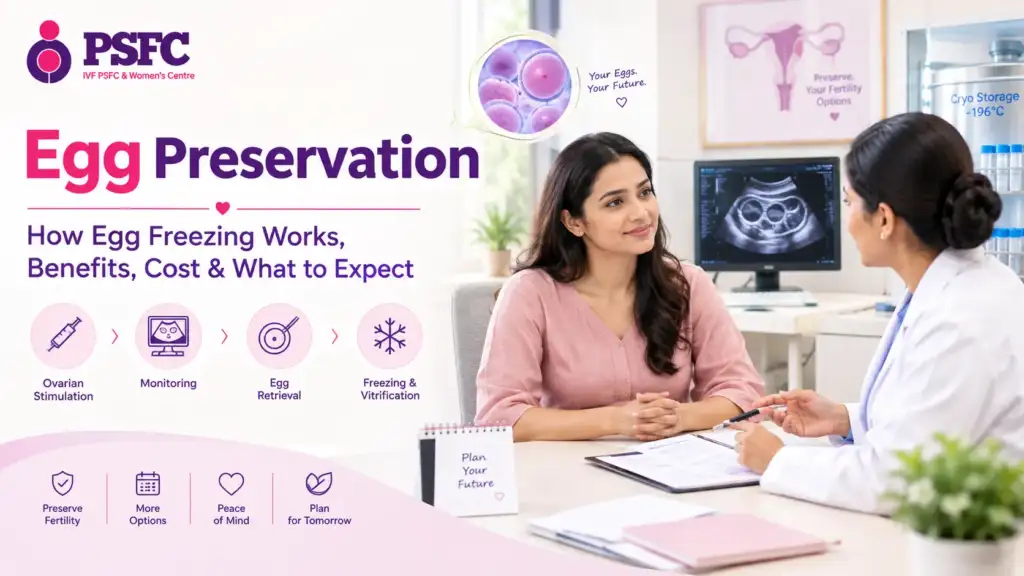
The process of egg freezing involves taking hormone medications, collecting mature eggs, and storing them. But why store them? There are factors that can affect egg quality, including the most common medical conditions in women, like polycystic ovary syndrome (PCOS) and endometriosis.
As you age, the quality and quantity of eggs start decreasing, and if you want to delay pregnancy due to career and financial stability, then egg preservation is the best choice. Some people have genetic conditions, and some undergo medical treatments that could affect fertility, and for all these cases, this method works the best.
The costs for egg preservation are high, as they cover the egg retrieval procedure, storage fees, and future expenses. If you are thinking about egg freezing, then this guide covers everything about the egg preservation process, including its benefits, costs, and what to expect.
How Egg Freezing Works?
Egg preservation, also called oocyte cryopreservation, involves retrieving unfertilised eggs from a woman and freezing them in liquid nitrogen.
The egg freezing process takes about 2 to 3 weeks, but most cycles take less than 2 weeks. Before undergoing the procedure, a medical examination will be done to observe the number of eggs remaining in the ovaries.
Freezing Process
1. Ovarian stimulation
This procedure is performed to produce multiple eggs. In general, ovaries produce only one egg in a single menstrual cycle, but if hormone medication is given, then it can produce many eggs at the same time. Mostly, follicle stimulation hormone and luteinising hormone will be given to stimulate multiple eggs. This increases the success rates of this procedure.
The type of medications to be used will be based on the observation and assessment of blood tests. About two or three hormonal injections will be given, and this process lasts for 10 to 12 days.
2. Monitoring
Ultrasound and frequent blood tests will be done to check the development of the eggs or for any abnormalities. The medications will be adjusted based on the monitoring.
3. Trigger injection
A trigger shot of human chorionic gonadotropin (hCG) will be received, and this is performed 36 hours before the retrieval.
4.Egg retrieval
Sedation is given on the day of retrieval to remove the eggs, and this process takes about 20 to 30 minutes. Through transvaginal ultrasound, a thin needle will be used to aspirate the fluid from the follicles containing eggs.
5. Post-procedure recovery
You may experience discomfort in the first 24 hours after the procedure, which can include mild cramping, bloating, constipation, and vaginal spotting, all of which are common. If the symptoms are severe, then it is recommended to contact your doctor.
6. Freezing
After retrieval, the eggs will be assessed for the quality and the quantity. Then the eggs will be frozen by a procedure called vitrification.
7.Vitrification
The oocytes will be frozen through immersion in liquid nitrogen, where the temperature remains at -196ºC, and this temperature is responsible for stopping the biological activity of the cell.
How Many Eggs Should Be Frozen?
Everything is related to age!
If you want to freeze your eggs, then the number of eggs to be retreived will depend on your age. As age increases, the number and quality of eggs decrease.
- As the quality of the eggs is higher in the 20s, the number of eggs needed is lower, around 10 to 15.
- If your age is around 30 and 34, then 17 to 20 eggs will be required for freezing.
- If you are around 35 and 37, then 21 to 27 mature eggs will be required.
- Around 32 to 50 eggs will be required if you are around 38 and 40.
- If your age is more than 40, then the number will be higher.
Points to note
The above numbers are the mature eggs required but not the total eggs retrieved.
After retrieval, only matured eggs are chosen because the eggs are mixed with immature, mature and overmature ones.
Not every matured egg undergoes freezing because some of them may show structural defects and abnormalities.
What Are the Benefits of Egg Freezing?
- When a woman wants to plan her life and delay pregnancy, then egg freezing is very beneficial.
- Women can focus on their career and education instead of worrying about their age and issues with fertility.
- It can increase the success rates for IVF if you are planning in the future.
- Women facing issues with PCOS and endometriosis can freeze their eggs while they are still healthy, as it can lead to fertility issues later.
- The female patients undergoing chemotherapy and radiation therapy or suffering from autoimmune disease can freeze the eggs.
What Is The Best Age to Freeze Your Eggs?
The best age to freeze eggs is between 25 and 35 to improve egg quality and quantity and increase future pregnancy chances.
The women in their 20s can produce more eggs in a single cycle, and most of the eggs will have normal chromosomes. The number of eggs will be decreasing in the mid-30s, and the quality and quantity of eggs will decrease gradually after the age of 40.
What Is the Success Rate of Frozen Eggs?
Factors such as age, health conditions, the method of egg preservation, the survival rate of the egg during thawing, the chosen fertility hospital, and the quantity and quality of the eggs all affect the egg freezing success rate.
- Age: quality and quantity of eggs decrease with age. The egg preservation must be done in the 20s or early 30s for higher success rates.
- Survival rate: There is a chance that the thawing can damage the egg, but the modern thawing methods can reduce the damages caused.
- Health conditions: People with reproductive health issues can face issues in egg freezing due to reduced success rates.
- Quantity and quality of the eggs: Success rates will be higher if the quantity and quality of the eggs are good enough.
- Egg preservation method: Freezing is of two types, fast and slow, and these methods can affect the survival rate of the eggs.
By the vitrification method, the survival of the eggs will be around 85 to 95 per cent, while the chances of birth per egg are around 2 to 12 per cent.
The birth rate for women freezing eggs in their 30s observed a 50-60% success, while for the women in the age range between 36 and 39, the success rate was around 30-40%, and after the age of 40, the success rate went below 20%.
What to Expect After Egg Preservation?
The retrieval process takes place around 20 to 30 minutes, and you can expect some of the symptoms after the procedure:
- Bloating: The ovaries enlarge after the process; hence, bloating can be a symptom and will be present for a couple of days.
- Fatigue: The procedure is done with anaesthesia, and stress will be caused due to hormone stimulation causing fatigue.
- Mild abdominal pain: Ovaries become delicate and swollen, causing discomfort and pain in the lower abdomen.
- Light spotting: A needle is used for retrieval, which can cause spotting.
- Dizziness: The anaesthesia can cause nausea or dizziness for some people.
The periods after the retrieval process are heavier than usual, and the symptoms could ease within 3 to 5 days after the process.
The next process involves freezing eggs for future pregnancy, and if the frozen eggs have to be used, they have to undergo:
- Thawing: Frozen eggs are warmed with a solution, and this process is done carefully to avoid damage to the eggs.
- Fertilisation: The eggs undergo a process called fertilisation where the sperm is injected into the healthy egg. The procedures can include IVF (in vitro fertilisation) or ICSI (intracytoplasmic sperm injection).
- Embryo development: Followed by fertilisation, the eggs will develop into embryos. Their growth is tracked for 3 to 5 days, and high-quality embryos are chosen for the next procedure.
- Embryo transfer: A thin tube, also called a catheter, is used to transfer the embryo into the uterus. The procedure takes around 15 to 20 minutes and is performed carefully by an embryologist.
- Pregnancy test: After two weeks of this procedure, a pregnancy test will be done to confirm the successful embryo implantation.
The success rate for the IVF and ICSI depends not only on the egg quality but also on the sperm quality. Hence, male reproductive health is also important to ensure high success rates. These procedures do not always become a success every time due to factors including age and health.
How Much Does Egg Freezing Cost?
The egg freezing costs include consultation, hormone stimulation, medications, monitoring, the egg retrieval process, freezing and storage. The cost breakdown is provided below:
| Components | Costs in Rupees |
| Consultation | 2000 to 15000 |
| Hormone stimulations | 50000 to 150000 |
| Medication | 20000 to 150000 |
| Monitoring | 5000 to 30000 |
| Egg retrieval procedure | 40000 to 100000 |
| Freezing | 30000 to 60000 |
| Storage | 10000 to 25000 per year |
Key Takeaways
- Egg preservation is the process of freezing eggs for fertility preservation in women due to genetic factors, lifestyle and other reasons.
- The process includes ovarian stimulation, monitoring, trigger injection, egg retrieval, freezing and vitrification.
- The number of eggs to be frozen will be based on the age, and the number of eggs collected increases with age.
- Women who want to delay pregnancy due to a career or have issues like PCOS and endometriosis can benefit from this.
- The best age to freeze eggs is usually between 25 and 35 years, as the quality and quantity of the eggs keep decreasing with age.
- After the egg retrieval procedure, you may notice symptoms like bloating, fatigue, abdominal pain, spotting, and dizziness.
- The costs for the egg preservation include consultation, hormone stimulations, medication, monitoring, egg retrieval procedure, freezing and storage.
Frequently Asked Questions
- Is performing egg retrieval a single time enough for egg preservation?
Performing the egg retrieval process once is not enough because of the egg count and the age factor.
- What are the costs for egg preservation?
The costs for egg preservation are between Rs 80000 and Rs 250000 for one cycle, depending on the hospital and the medications.
- What is the best age for egg freezing?
The best age for egg freezing is between 25 and 35 years of age.
- What are the side effects after the egg retrieval process?
The side effects include bloating, abdominal pain, fatigue, spotting and dizziness.
- Will the egg freezing process affect my health?
The egg freezing process is safe and does not cause any issues to your health.
- What tests need to be performed before egg freezing?
Transvaginal ultrasound and blood tests like anti-Mullerian hormone (AMH) are needed to be performed before the egg freezing process.
