

Obesity and Fertility: Losing Weight Could Boost Conception by 47%
 By Chitra Shankar
If you’ve been trying to get pregnant and someone has brought up your weight, chances are it didn’t land well. It’s an awkward thing for anyone to raise, and it can feel a lot more like blame than information. So let’s start somewhere more useful obesity and fertility are linked through biology, not judgment. And once you understand how, that connection turns out to be genuinely encouraging because the same factor making conception harder is also one of the few things in this whole picture that you actually have some control over.
This guide covers what’s actually going on in the body, what recent research says about weight loss and conception, and what a realistic, non-extreme approach can look like for women and for men.
What the Research Actually Shows
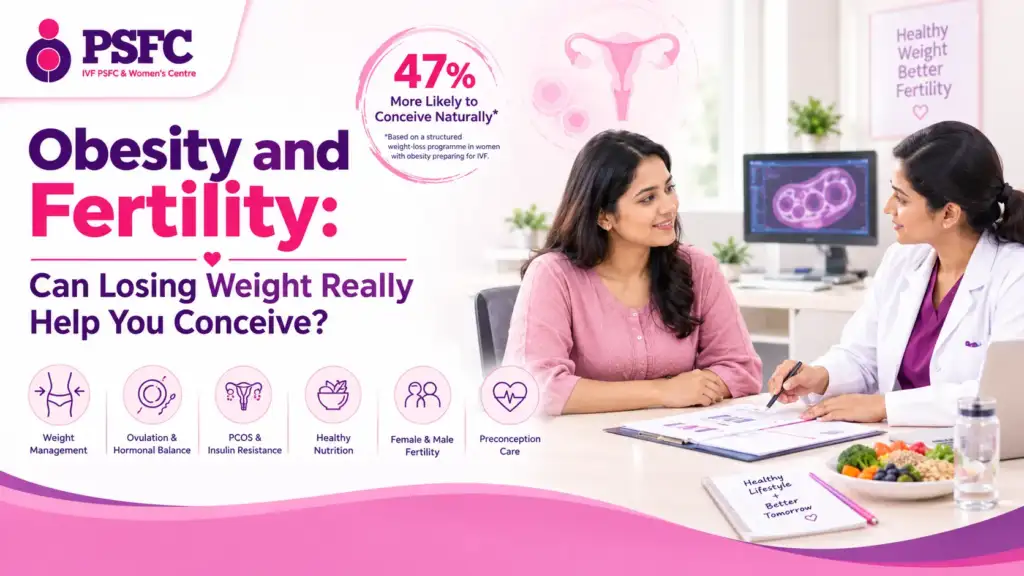
A large 2025 systematic review out of the University of Oxford, published in the Annals of Internal Medicine, followed women with obesity who went through a structured weight-loss programme before starting IVF. The result: they were 47% more likely to conceive naturally no IVF required than women who got little or no weight-loss support. The same review found that weight-loss support raised the odds of any pregnancy, natural or IVF-assisted, by 21%.
It’s worth being precise about what that 47% figure actually covers. It applies to women with obesity who were already on the path toward IVF and went through a structured weight-loss intervention first not to anyone who happens to drop a few pounds. Even with that caveat, though, it’s a striking finding, because it points to something more hopeful than the usual story: weight loss doesn’t just clear a barrier to treatment. On its own, it can shift the odds.
There’s a second reason this matters. In some healthcare systems, funded IVF simply isn’t available above a certain BMI. Findings like this suggest that structured weight-loss support isn’t only a box to check before treatment opens up it can be a legitimate route to pregnancy in its own right, and sometimes IVF turns out not to be necessary at all.
How Obesity Affects Fertility in Women
How obesity affects fertility in women largely comes down to disrupted hormone signalling. Fat tissue isn’t inert storage it’s hormonally active, producing oestrogen and influencing insulin levels. With excess fat tissue, that hormonal activity can interfere with the signalling between the brain and ovaries that keeps ovulation on schedule.
The practical result is often anovulation cycles where no egg is released or cycles that are irregular enough to make timing conception genuinely difficult. Obesity is also closely tied to insulin resistance, which adds another layer to the hormonal disruption. And when conception does happen, obesity is associated with a higher risk of early miscarriage, which is one more hard thing layered onto an already hard process.
Weight can also complicate fertility treatment itself, when treatment is needed. Higher BMI is linked to requiring higher doses of ovarian stimulation medication during IVF, a somewhat blunted response to that stimulation, and occasionally more technically difficult egg retrieval or embryo transfer. None of that means treatment won’t work it does, for many women but it’s a big part of why addressing weight beforehand, when realistic, tends to come up in a fertility specialist’s recommendations rather than as an unrelated aside.
How Obesity Affects Fertility in Men
This side of the story gets a lot less airtime, but it’s just as real. Obesity in men is associated with lower testosterone, higher oestrogen (fat tissue converts testosterone into oestrogen), and measurable drops in sperm count, motility, and normal sperm shape. It can also contribute to erectile difficulties, and it’s linked to conditions like diabetes and high blood pressure that independently affect fertility.
If a couple is struggling to conceive, it’s worth remembering this isn’t automatically a “her problem.” Looking at both partners’ health weight included gives a far more accurate read on what’s actually happening. Male factors are behind roughly half of all infertility cases, and weight is one of the more overlooked, modifiable pieces of that picture, often only addressed after months spent focused entirely on the female partner.
PCOS and Weight Loss for Fertility
PCOS and weight loss for fertility deserve a section of their own, because polycystic ovary syndrome sits right at the crossroads of obesity and infertility for a huge number of women. PCOS is one of the most common causes of ovulatory infertility, and it’s frequently though not always paired with insulin resistance and weight gain that’s genuinely hard to shift through diet and exercise alone, simply because of how the condition affects hormones.
Here’s the encouraging part: research consistently shows that even modest weight loss often cited as somewhere around 5 to 10% of body weight can be enough to restore ovulation in many women with PCOS, sometimes without any other intervention. That’s a much smaller target than most people assume when they hear “lose weight for fertility,” and it’s worth knowing, because the goal here isn’t a total transformation. It’s a realistic, achievable shift that can change hormonal signalling enough to make a real difference to your cycle.
Weight Loss and Ovulation: How Are They Connected?
The link between weight loss and ovulation runs on the same hormonal pathway described above, just in reverse. As fat tissue decreases, oestrogen and insulin levels tend to settle back toward normal, which helps restore the brain-to-ovary signalling that regular ovulation depends on. This is part of why weight loss can improve fertility even before someone reaches a “normal” BMI the hormonal benefits tend to build gradually, alongside gradual weight change, rather than switching on once a specific number on the scale is hit.
Does Weight Loss Improve Fertility? What to Expect
Does weight loss improve fertility in every case? No infertility can have several contributing causes, and weight is sometimes one factor among many, not the whole story. But for people whose fertility struggles are tied to ovulatory dysfunction linked to weight, the research is genuinely encouraging.
The timeline is the part worth setting realistic expectations around. Hormonal change from weight loss doesn’t happen overnight, and most fertility specialists recommend a structured approach spread over several months rather than a rapid, extreme one rapid weight loss can disrupt hormonal balance in the short term, which works against the goal. Slow, sustainable weight loss, through diet changes, regular movement, and sometimes medical support, tends to produce steadier, more lasting improvements in ovulation than crash approaches do.
Obesity and Pregnancy Complications
Even once conception happens, obesity and pregnancy complications remain connected in ways worth knowing ahead of time, rather than discovering mid-pregnancy. Obesity during pregnancy is associated with a higher risk of gestational diabetes, preeclampsia, and needing a caesarean delivery. It’s also linked to a higher chance of the baby being born significantly larger than average, which brings its own delivery-related risks.
None of this means a healthy pregnancy isn’t possible plenty of women with obesity have completely healthy pregnancies. But it’s a big part of why working on weight, where realistic, before conception can benefit not just your chances of getting pregnant, but the pregnancy that follows. Preconception care that includes weight management is increasingly recommended for exactly this reason: it’s usually easier and safer to address beforehand than to manage once pregnancy is already underway.
How Much Weight Loss Is Enough?
There’s no single number that applies to everyone, but the research consistently points to modest, sustained weight loss mattering more than reaching an “ideal” weight. For many women particularly those with PCOS that 5–10% of body weight range shows up again and again in the clinical literature as the point where meaningful hormonal improvement tends to start. For men, similarly modest weight loss has been shown to improve sperm count and quality within a few months. Sperm takes roughly three months to fully develop, so changes made now tend to show up in sperm quality later, not right away.
Practical Steps Toward Better Fertility Through Weight Management
None of this requires overhauling your life overnight if anything, the research suggests that’s the wrong approach. A few things worth keeping in mind as you figure out where to start:
- Start with realistic, sustainable changes. Consistent moderate exercise and balanced eating tend to beat extreme short-term diets when it comes to fertility outcomes specifically.
- Address insulin resistance directly, where it’s relevant it’s often the hidden link between weight and ovulatory problems, especially with PCOS. A doctor may recommend targeted testing or medication alongside lifestyle changes, not instead of them.
- Involve both partners, if you’re trying as a couple. Male fertility factors are frequently under-discussed but equally relevant, and tackling weight together can also make the process feel less isolating for whichever partner is carrying more of the perceived responsibility.
- Work with a specialist rather than going it alone, particularly if PCOS, insulin resistance, or a longer fertility struggle is part of the picture. A tailored plan tends to succeed where generic advice doesn’t.
- Give it time. Three to six months of consistent change is a far more realistic window for hormonal improvement than a few weeks.
- Be wary of extreme or rapid weight-loss approaches. Crash diets and very low-calorie plans can disrupt hormonal balance in the short term, sometimes working against the very outcome you’re aiming for.
If there’s one thing to take from this list, make it the timeline. It’s easy to feel like every month without a change is a month lost, but rushing the process rarely helps and can actively work against you. Slow, steady change isn’t a consolation prize here it’s genuinely the more effective path.
Frequently Asked Questions
1. How much weight loss improves fertility?
Even a modest reduction of around 5–10% of body weight can restore ovulation in many women, particularly those with PCOS-related infertility.
2. Does obesity affect male fertility too?
Yes. Obesity in men is linked to lower testosterone, reduced sperm count and motility, and a higher likelihood of erectile difficulties.
3. Can losing weight really increase the chance of natural conception?
A major 2025 systematic review found that women with obesity were 47% more likely to conceive naturally after a structured weight-loss programme than those without one though that specific figure applies to women who were preparing for IVF, so individual results will vary.
4. Is PCOS the main reason obesity affects fertility?
Not the only reason, but it’s one of the most common. PCOS frequently involves both insulin resistance and ovulatory dysfunction, and both are closely tied to weight.
5. Are there pregnancy risks linked to obesity even after conceiving?
Yes. Obesity during pregnancy is associated with higher risks of gestational diabetes, preeclampsia, and delivery complications, which is part of why addressing weight beforehand, where possible, is often recommended as part of preconception care.
