


If you’ve found yourself here, you’re probably somewhere in the middle of a hard question: why can’t my body do this, and what does that actually mean for becoming a parent? It’s a strange, lonely feeling being told surrogacy might be your path forward, without anyone really sitting down and explaining why.
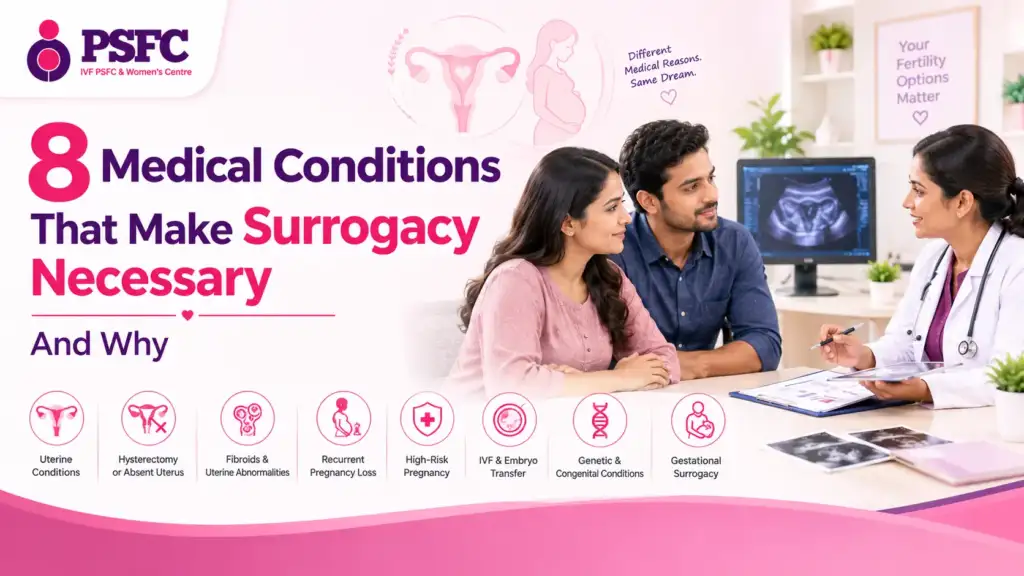
So let’s do that. Here are the eight medical conditions for surrogacy that come up most often, what’s actually happening in each one, and why surrogacy ends up being the answer rather than something else.
What Are the Medical Conditions for Surrogacy?
Before getting into the list, it helps to understand the shape of the problem. Medical conditions for surrogacy generally fall into two buckets: conditions where a woman’s body simply cannot carry a pregnancy at all, and conditions where it technically could, but doing so would put her health or life at serious risk. Some of these are things a woman was born with. Others develop later after an illness, a surgery, or a string of pregnancies that didn’t survive.
None of them are anyone’s fault. None of them say anything about whether someone will be a good parent. They just mean the pregnancy part of the journey needs to happen somewhere else and understanding exactly why can make the decision feel less like a loss and more like a plan.
1. Born Without a Functioning Uterus (MRKH Syndrome)
Some women are born without a uterus, or with one that never fully developed a condition called Mayer-Rokitansky-Küster-Hauser (MRKH) syndrome. It’s more common than most people assume, affecting roughly 1 in 5,000 women, and it’s usually discovered during the teenage years, when periods simply don’t start.
Here’s the part that surprises people: most women with MRKH have completely normal, functioning ovaries. Their eggs are healthy. What’s missing is the organ that would carry a pregnancy, not the ability to produce a child biologically. Through IVF, those eggs can be fertilized and the resulting embryo carried by a gestational surrogate so the baby is still genetically hers, even though someone else does the carrying. Uterus transplantation exists as a newer option for a small number of women with MRKH, but it’s a major surgery that isn’t widely available or right for everyone, which is why surrogacy remains the more established route.
2. Surrogacy After Hysterectomy or Uterus Removal
A uterus that once worked perfectly well sometimes has to be removed later in life because of cancer, a severe infection, or a life-threatening complication from a previous birth.
Without a uterus, pregnancy simply isn’t physically possible, no matter how healthy everything else is. But hysterectomies don’t always involve removing the ovaries, so many women in this situation can still use their own eggs. That’s the door surrogacy after hysterectomy opens: the biology of motherhood stays intact, even after the organ needed to carry a pregnancy is gone.
3. Severe Fibroids and Asherman’s Syndrome
Uterine fibroids are non-cancerous growths, and most of the time they’re manageable or don’t interfere with fertility at all. But in severe cases, they distort the shape of the uterus so much that an embryo can’t implant, or a pregnancy can’t develop safely. Asherman’s syndrome is a different but related problem scar tissue inside the uterus, usually from a previous surgery or infection, that can quietly make the uterine lining inhospitable to a pregnancy.
When these issues can’t be resolved surgically, or surgery has been tried without success, surrogacy stops being a fallback and starts being the more sensible choice rather than continuing to try for something the uterus structurally can’t support.
4. Recurrent Pregnancy Loss and Surrogacy
This is, for many people, the hardest path to this list because it usually comes after real hope, more than once, followed by real loss.
Recurrent pregnancy loss and surrogacy are connected for a specific medical reason. When multiple miscarriages happen despite healthy embryos and no chromosomal explanation, doctors sometimes find that the problem isn’t the embryo at allit’s the uterine environment itself. Blood flow, lining thickness, or an underlying immune response can quietly prevent implantation or early pregnancy from succeeding, even when everything else checks out. Using a gestational surrogate removes that specific obstacle while keeping the intended parents’ own genetic material in the picture. If this is where you are, it’s worth naming honestly: the emotional toll of repeated loss is real, and needing time before feeling ready for the next step isn’t a setback it’s just human.
5. High-Risk Pregnancy and Surrogacy
Some women could conceive without any trouble at all the problem isn’t getting pregnant, it’s that pregnancy itself would be dangerous for them.
High-risk pregnancy and surrogacy tend to intersect around conditions like severe heart disease, advanced kidney disease, uncontrolled high blood pressure, or certain autoimmune disorders. The physical demands pregnancy places on the body increased blood volume, added strain on the heart and kidneys, hormonal shifts can turn an already serious condition into a genuinely life-threatening one. In these cases, surrogacy isn’t recommended because anything is wrong with fertility. It’s recommended because a doctor isn’t willing to gamble a mother’s life on a pregnancy her body may not safely withstand.
6. Repeated IVF Failure: Surrogacy for Medical Reasons
Sometimes everything looks right on paper good eggs, healthy embryos, no red flags and implantation still doesn’t happen, cycle after cycle.
After several unexplained failed embryo transfers using genetically normal embryos, doctors sometimes conclude that the uterine environment itself is the limiting factor, not the embryo or the broader treatment plan. This is one of the clearest examples of surrogacy for medical reasons: a targeted solution for one specific, identified obstacle, not a verdict on the rest of the fertility journey. It’s a hard thing to hear after everything already invested, but it’s often the piece that finally makes the path forward click into place.
7. Genetic and Congenital Conditions That Make Pregnancy Dangerous
Two related situations sit here. Some inherited genetic conditions can make pregnancy risky for the mother, or in certain cases, create serious complications for the baby if carried by the biological mother. Separately, some women are born with a uterus or cervix that’s structurally unusual beyond MRKH a cervix that can’t support the weight of a pregnancy and can’t be surgically corrected, or a uterine shape that consistently prevents a pregnancy from developing, even after attempts to fix it.
For genetic conditions, surrogacy offers a way to still have a genetically related child while removing the specific risk pregnancy would introduce usually worked through carefully with a genetic counsellor alongside a fertility specialist. For structural issues that surgery can’t resolve, surrogacy offers a path that doesn’t depend on repeating procedures that haven’t worked.
Who Needs Surrogacy? How to Know If It’s Right for You
If you’re still asking who needs surrogacy, here’s the honest, unglamorous answer: anyone whose body can’t safely carry a pregnancy, whether that’s something they were born with or something that developed later. It’s almost never a first choice. Most people arrive here after trying other paths, working through treatment options, and slowly understanding often with real difficulty exactly what’s happening in their own case.
A thorough consultation is usually the starting point: imaging of the uterus, a full review of fertility and pregnancy history, and genetic or hormonal testing where relevant. From there, a fertility specialist can help map out whether surrogacy is genuinely the right next step, or whether other options are still worth trying first. It’s also completely reasonable to ask for a second opinion, or simply more time, before committing to that decision this isn’t a call anyone should feel rushed into.
Gestational Surrogacy vs. Traditional Surrogacy
It’s worth clearing up a common confusion while you’re thinking this through. In gestational surrogacy, the surrogate carries a pregnancy created from the intended parents’ own egg and sperm (or donor gametes, if needed) she has no genetic connection to the baby. In traditional surrogacy, the surrogate’s own egg is used, making her the biological mother. Gestational surrogacy is far more common today, largely because it keeps the genetic link with the intended parents and avoids the added legal and emotional complexity of the surrogate also being the biological mother. Nearly every condition on this list leads toward gestational surrogacy specifically the issue is almost always about carrying the pregnancy, not about the eggs or genetic material themselves.
What the Process Actually Looks Like
Once surrogacy is identified as the right path, it typically unfolds in stages: confirming the diagnosis with your fertility team, creating embryos through IVF, finding and screening a surrogate (a process that varies a lot depending on local laws), and then the embryo transfer itself. Most intended parents stay closely involved throughout attending appointments, tracking every milestone, being present in every way that matters, just from a different vantage point than carrying the pregnancy themselves. It’s as much an emotional process as a medical one, and leaning on your care team, and often a counsellor, along the way isn’t a sign of struggling. It’s just part of doing this well.
Frequently Asked Questions
What makes you ineligible for surrogacy?
Surrogacy may not be suitable for everyone. Your medical history, fertility condition, previous treatments, overall health, and local legal requirements can affect eligibility. Some people may need other fertility treatments instead, while certain medical or legal factors may prevent them from proceeding. A fertility specialist can review your health and treatment history to determine whether surrogacy is an appropriate option for you.
How much does surrogacy cost for a single man?
There is no single fixed cost for surrogacy. The total expense can vary depending on IVF treatment, donor eggs, medical care, surrogate-related expenses, and legal requirements. The cost also differs based on the treatment plan and location. It is best to discuss your situation with a fertility specialist to understand the expected expenses.
What are the most common medical conditions for surrogacy?
The most common include absolute uterine factor infertility (such as MRKH syndrome), uterus removal due to hysterectomy, severe fibroids or Asherman’s syndrome, recurrent pregnancy loss, and high-risk health conditions like severe heart or kidney disease.
Is recurrent pregnancy loss always a reason for surrogacy?
Not always. Many causes of recurrent pregnancy loss can be treated directly. Surrogacy usually becomes the path forward only after other causes have been ruled out or treated without success.
