

Egg, Sperm & Embryo Freezing: Complete Guide
 By Pearl Editor
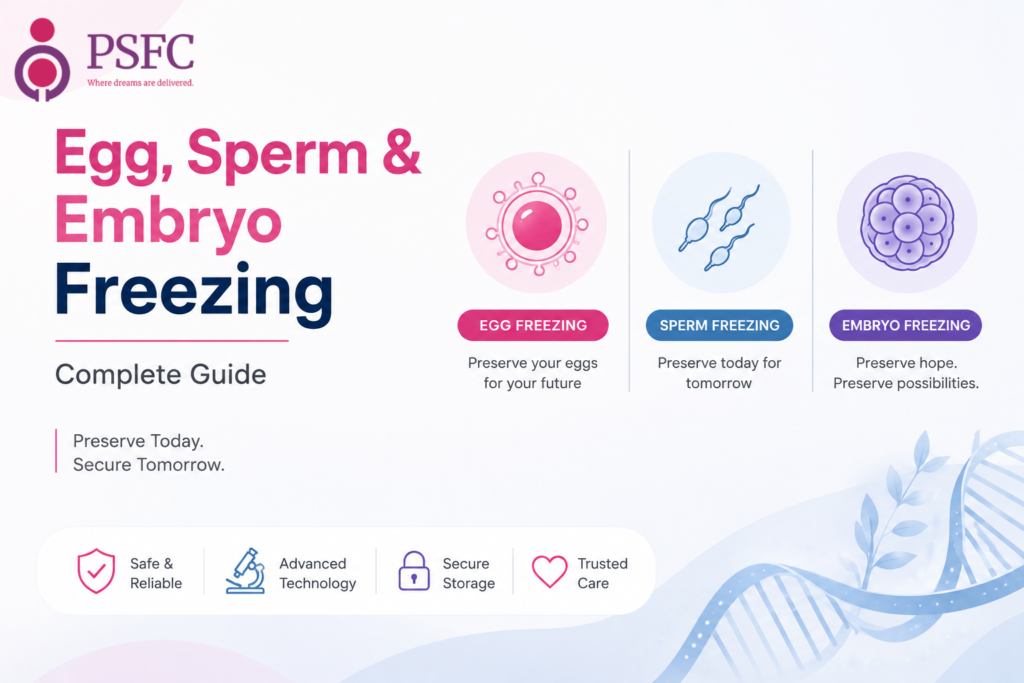
Life doesn’t always follow the timeline we plan for fertility. A cancer diagnosis arrives before you’re ready to have children. A career demands another few years. A relationship isn’t yet where it needs to be. Or perhaps a medical condition is quietly reducing your reproductive window faster than you expected.
Fertility preservation — freezing eggs, sperm, or embryos — exists precisely for these situations. It’s the science of pausing your biological clock at its current state, banking your reproductive potential, and using it when the time is actually right for you.
The technology behind it has advanced dramatically over the past two decades. Survival rates for frozen eggs have climbed from around 61% to over 90% with modern vitrification techniques. Frozen embryo transfers now match — and in some outcomes, exceed — fresh transfer success rates. Sperm frozen decades ago has successfully fathered children.
This guide explains each method clearly: what happens during the process, who it’s best suited for, what the success rates actually mean, and what you need to think through before making a decision.
Modern vitrification technology has raised frozen egg survival rates to over 90%, up from 61% with older methods. Frozen embryo transfers now achieve success rates equal to or greater than fresh transfers. For anyone facing cancer treatment, elective delay, or declining ovarian reserve, fertility preservation is a clinically proven option — with the best outcomes for egg freezing between ages 28 and 35.
What Is Egg Freezing and How Does It Work?
Egg freezing — medically known as oocyte cryopreservation — is one of the most significant advances in reproductive medicine over the past two decades. A woman is born with roughly 1–2 million eggs, a number that drops to around 300,000 by puberty and continues declining steadily from there. By age 37, both egg quantity and quality decrease significantly — which is why the timing of preservation matters enormously.
The process works by stimulating the ovaries to produce multiple eggs in a single cycle, retrieving those eggs before ovulation, and freezing them at the point of peak quality for future use. Frozen eggs experience no biological ageing during storage — a 32-year-old’s eggs remain biologically 32 whether they’re used one year or ten years later.
The Egg Freezing Process Step by Step
Ovarian stimulation (10–14 days): Injectable hormones—FSH (follicle-stimulating hormone) and LH (luteinizing hormone)—are administered daily to stimulate the ovaries to develop multiple follicles simultaneously. In a natural cycle, only one follicle matures; stimulation can yield 8–15 eggs in a single cycle depending on ovarian reserve.
Monitoring: Regular ultrasound scans and blood tests track follicle growth and estrogen levels throughout stimulation. This close monitoring allows the clinical team to adjust medication and time the trigger injection precisely.
Trigger injection: A final injection of HCG or a GnRH agonist is given exactly 34–36 hours before egg retrieval. This triggers the final maturation of eggs before collection.
Egg retrieval (OPU): Under light sedation, a thin ultrasound-guided needle passes through the vaginal wall to aspirate eggs from each follicle. The procedure takes approximately 20 minutes, and most women go home the same day with minimal discomfort.
Vitrification: This is where modern technology makes a critical difference. Vitrification is ultra-rapid freezing that converts the egg to a glass-like state within milliseconds—preventing the ice crystal formation that damaged eggs under older slow-freeze methods. Survival rates post-thaw are now over 90%, compared to approximately 61% with earlier techniques. Frozen eggs are stored in liquid nitrogen at -196°C indefinitely.
Citation capsule: Since the introduction of vitrification technology, frozen egg survival rates have risen from approximately 61% to over 90%, according to reproductive endocrinology research. Each frozen egg carries a 5–10% individual chance of resulting in a live birth, making the recommended target of 10–15 mature eggs a clinically meaningful benchmark for cumulative conception success.
Who Should Consider Egg Freezing — And What’s the Best Age?
Egg freezing is most commonly chosen by women between 25 and 35 who are delaying childbearing for personal, professional, or relationship reasons. But it’s also a medically critical option for specific health situations where fertility may be at risk.
Medical Reasons
Women diagnosed with cancer who require chemotherapy or radiation should be offered fertility preservation before treatment begins—both treatments can permanently damage ovarian function. Women with endometriosis, which progressively affects egg-producing tissue, often benefit from early preservation before further ovarian damage occurs. Women with premature ovarian insufficiency, or a family history of early menopause, face a narrower biological window that makes preservation more time-sensitive than for the general population.
Elective Preservation
For women choosing to delay pregnancy, the data is clear: eggs frozen before 35 produce significantly better outcomes than those frozen after 37. Eggs retrieved at 34 have a considerably higher live birth rate than eggs retrieved at 38 or older — not because the technology changes, but because the biological quality of the eggs themselves changes with age.
How Many Eggs Are Enough?
This is one of the most important practical questions. Each frozen mature egg carries an average of a 5–10% chance of resulting in a live birth. To achieve a meaningful cumulative pregnancy probability, reproductive specialists generally recommend having 10–15 mature eggs in storage. One cycle doesn’t always yield this number—women with lower ovarian reserve may require two cycles to reach their target bank.
Many women assume one egg retrieval cycle is sufficient. In reality, egg banking is often a cumulative process. Understanding your AMH level and antral follicle count before starting tells you how many cycles you’ll likely need — and changes the financial and logistical planning entirely. Asking this question before cycle one, not after, is one of the most practical steps a woman can take.
What Is Sperm Freezing and Why Is It Simpler Than You Think?
Sperm cryopreservation is the most established form of fertility preservation — successfully performed since the early 1950s, with documented cases of men fathering children from sperm frozen over 20 years prior. Compared to egg freezing, it’s simpler, faster, less expensive, and carries a lower procedural burden.
Sperm quality, unlike egg quality, is not fixed at birth. It’s actively influenced throughout a man’s life by age, heat exposure, stress, smoking, medications, and other lifestyle factors. Sperm quality begins a gradual but measurable decline after age 40, driven by accumulating DNA fragmentation—which can affect embryo quality and increase miscarriage rates in partners.
The Sperm-Freezing Process
Sample collection: Semen is collected through ejaculation into a sterile container, either at the clinic or at home with rapid transport. Collecting 2–3 samples over several days allows a larger number of motile sperm to be banked for future use.
Semen analysis: Before freezing, the sample is analyzed for volume, sperm count, motility (movement), and morphology (shape). This baseline assessment guides how the sample is processed.
Cryoprotective agent: A specially formulated antifreeze solution is added to the sperm before freezing, protecting cells from damage during the freezing process.
Vitrification and controlled freezing: Both rapid vitrification and controlled slow freezing are used for sperm. Samples are divided into multiple straws so that not all sperm are thawed at once — preserving the bank for multiple future attempts.
Storage: Sperm is stored in liquid nitrogen. Many men have successfully used frozen sperm for IVF and ICSI more than 20 years after initial freezing.
What If a Man Can’t Produce Sperm Through Ejaculation?
Men with spinal cord injuries, obstructive azoospermia, or other conditions that prevent ejaculation can still preserve fertility through surgical sperm retrieval. Procedures like TESA (testicular sperm aspiration) or TESE (testicular sperm extraction) retrieve sperm directly from testicular tissue under local anesthesia—which can then be frozen and used for future ICSI cycles.
Who Should Consider Sperm Freezing?
- Men about to begin chemotherapy or radiation therapy
- Men considering a vasectomy who want a future option preserved
- Men in high-risk occupations (military deployment, hazardous environments)
- Men who won’t be present during their partner’s fertile window
- Men whose semen analysis has shown a declining trend
- Men who want a long-term reproductive backup plan
Success Rates and Cost
Frozen sperm used in IVF with ICSI achieves pregnancy rates very close to fresh sperm. After thawing, motile sperm survival typically ranges from 50 to 70 percent—but because millions of sperm are frozen, sufficient numbers of motile sperm remain available for fertilization. Clinically, pregnancy rates from frozen and fresh sperm in IVF are comparable.
In India, sperm freezing is the most affordable fertility preservation option available. Initial freezing typically costs ₹5,000–₹15,000—compared to ₹80,000–₹150,000 or more for a complete egg freezing cycle.
Citation capsule: Sperm cryopreservation has been successfully performed since the early 1950s, with documented pregnancies from sperm frozen over 20 years prior. Post-thaw motile sperm survival rates of 50–70% are sufficient for IVF and ICSI, with pregnancy rates comparable to fresh sperm cycles. In India, initial sperm freezing costs ₹5,000–₹15,000, making it the most accessible form of fertility preservation available.
What Is Embryo Freezing and Why Do Many Specialists Recommend It?
Embryo freezing combines the egg and sperm freezing processes—eggs are retrieved, fertilized in the laboratory, cultured for 3–6 days, and the resulting embryos are frozen rather than transferred immediately. The world’s first baby born from a frozen embryo arrived in Australia in 1984. Today, many fertility centers report frozen embryo transfer (FET) success rates equal to or exceeding fresh transfers.
The Embryo Freezing Process
Ovarian stimulation and egg retrieval: Identical to the egg freezing process described above.
Fertilization: Retrieved eggs are fertilized using conventional IVF (sperm placed near the egg) or ICSI (a single sperm injected directly into each egg). ICSI is now more commonly used—particularly when sperm quality is a concern—as it maximizes fertilization rates.
Embryo culture: Fertilized eggs develop in the laboratory for 3–6 days. Most clinics allow development to the blastocyst stage (day 5–6) before freezing, as blastocysts have significantly higher implantation rates than earlier-stage embryos.
Genetic testing (optional): Preimplantation Genetic Testing for Aneuploidy (PGT-A) can identify chromosomal abnormalities in blastocysts before freezing. This allows the selection of chromosomally normal (“euploid”) embryos—the ones most likely to implant and develop into a healthy pregnancy.
Vitrification and storage: Selected embryos are vitrified and stored in liquid nitrogen, ready for future transfer.
Frozen Embryo Transfer (FET): When ready to conceive, the uterine lining is prepared either through a natural cycle or with hormone therapy. One or two thawed embryos are transferred via a thin catheter in a procedure similar to a cervical smear—typically painless and requiring no anesthesia.
Why Is Frozen Embryo Transfer Often Preferred Over Fresh?
The hormonal medications used during ovarian stimulation can affect the uterine lining, sometimes making it less receptive to implantation during a fresh transfer cycle. Freezing embryos gives the uterus time to recover naturally before transfer—creating a more favorable environment.
Multiple embryology studies now indicate that FET outcomes are at least equal to, and for certain risk profiles superior to, fresh transfers—with lower rates of ovarian hyperstimulation syndrome (OHSS) and reduced rates of preterm birth.
Who Is Embryo Freezing For?
Embryo freezing is recommended for couples undergoing IVF who produce surplus embryos beyond what’s transferred in the first cycle, women or couples using donor sperm, individuals who want the highest cumulative pregnancy probability from a single stimulation cycle, and anyone who wants genetic testing before transfer.
Embryo freezing offers something egg freezing alone cannot: certainty of fertilisation. A frozen egg still needs to be successfully fertilised after thawing — which isn’t guaranteed. A frozen embryo has already passed that hurdle. For couples who have both partners’ fertility to work with, embryo banking provides a more complete picture of reproductive potential before storage begins.
Citation capsule: The first baby born from a frozen embryo was delivered in Australia in 1984. Today, frozen embryo transfer success rates match or exceed fresh transfers at many fertility centers, with studies showing lower rates of ovarian hyperstimulation syndrome and preterm birth with FET protocols. For couples undergoing IVF, freezing surplus embryos significantly increases the cumulative probability of a live birth from a single stimulation cycle.
Egg vs Sperm vs Embryo Freezing: Which Is Right for You?
| Factor | Egg Freezing | Sperm Freezing | Embryo Freezing |
|---|---|---|---|
| Who it’s for | Women / those with ovaries | Men / those with testes | Couples or individuals with a sperm source |
| Process duration | 2 weeks per cycle | 1–3 days | 2 weeks per cycle |
| Hormonal injections | Yes | No | Yes |
| Fertilisation required | No | No | Yes |
| Storage duration | 10+ years | 20+ years | 10+ years |
| Cost (India) | ₹80,000–₹150,000+ | ₹5,000–₹15,000 | ₹1,00,000–₹2,00,000+ |
| Best for | Single women, medical reasons | Medical, career, backup | Couples, IVF surplus embryos |
What Should You Think Through Before Freezing?
Timing is critical.
Egg quality decreases progressively with age. The optimal window for elective egg freezing is 28–35. After 37, ovarian response to stimulation decreases significantly—it may take multiple cycles to collect sufficient eggs, increasing both cost and time. Don’t wait for a “better” moment. The biological window is finite.
Understand the Full Cost Picture
The initial cycle cost is only the beginning. Annual storage fees, medication costs for future thaw and transfer cycles, and potential additional stimulation cycles all add up. Discuss the full financial picture with your clinic before committing.
Get the Right Tests First
Before any preservation procedure, baseline testing is essential:
- AMH (Anti-Müllerian Hormone) blood test — predicts ovarian reserve and likely response to stimulation
- Antral Follicle Count (AFC) — ultrasound count of resting follicles, confirming AMH findings
- Semen analysis—for sperm freezing, establishes current sperm parameters
These tests take days, not weeks, and fundamentally shape what preservation plan makes sense for your situation.
Know the Legal Framework
Under India’s Assisted Reproductive Technology (Regulation) Act 2021, both genetic contributors jointly own any frozen embryo. Signed consent agreements about the future use of embryos—especially if relationship status changes—are not just recommended; they’re legally and ethically essential before embryo freezing begins.
Frequently Asked Questions
What is the best age to freeze eggs?
The optimal age range for elective egg freezing is 28–35. Eggs frozen before 35 carry significantly higher live birth rates than those frozen after 37. After 40, the response to ovarian stimulation decreases substantially and egg quality declines, meaning multiple cycles may be needed to collect 10–15 viable eggs. Earlier preservation consistently produces better outcomes.
How long can frozen eggs, sperm, and embryos be stored?
Frozen eggs and embryos can be stored for 10 years or more without loss of viability — biological ageing stops entirely during storage in liquid nitrogen at -196°C. Sperm has been stored for over 20 years and successfully used in IVF. Storage duration limits in India are governed by the ART Regulation Act 2021 and may vary by clinic.
Is egg freezing painful?
The injections during stimulation cause mild discomfort at the site. The egg retrieval procedure is performed under light sedation, so most women feel nothing during the procedure itself. Some experience mild cramping or bloating for 1–2 days after retrieval. Serious complications like ovarian hyperstimulation syndrome (OHSS) are uncommon with modern monitoring protocols.
What is the success rate of frozen embryo transfer (FET)?
FET success rates vary with age and embryo quality but are broadly comparable to fresh transfers — and in several clinical outcomes, superior. Clinics using PGT-A tested blastocysts routinely report FET success rates of 50–70% per transfer in women under 35. Success rates decline with age, which is why the age at which embryos are frozen matters more than the age at which they are transferred.
How much does egg freezing cost in Chennai?
Egg freezing costs in Chennai typically range from ₹80,000 to ₹1,50,000 per cycle, including stimulation medications, monitoring, retrieval, and initial storage. Annual storage fees and future thaw-and-transfer cycles are additional costs. PSFC offers comprehensive fertility preservation consultations to help you understand the full cost picture before you begin.
The Bottom Line
Fertility preservation is no longer experimental — it’s an established, evidence-backed medical option that gives people genuine control over their reproductive timeline. Whether you’re facing a medical situation that threatens your fertility, buying time for the right circumstances, or simply being thoughtful about an uncertain future, freezing eggs, sperm, or embryos is an act of informed planning.
Key takeaways:
- Vitrification has raised frozen egg survival rates from 61% to over 90%
- The ideal age for elective egg freezing is 28-35—earlier always produces better outcomes
- Sperm freezing is the simplest, most affordable preservation option (₹5,000–₹15,000 in India)
- Frozen embryo transfers now match or exceed fresh transfer success rates
- AMH testing and antral follicle counts should be done before any preservation decision
- India’s ART Act 2021 requires signed consent agreements for frozen embryos—especially for couples
If you’re considering fertility preservation in Chennai and want to understand which option fits your age, health history, and goals—the PSFC team is here to help.
Visit PSFC Fertility Centre to book a consultation and preserve your options before the window changes.
