

What Is a Blastocyst? Meaning, Stages, Grading & Success Rate in IVF
 By Chitra Shankar
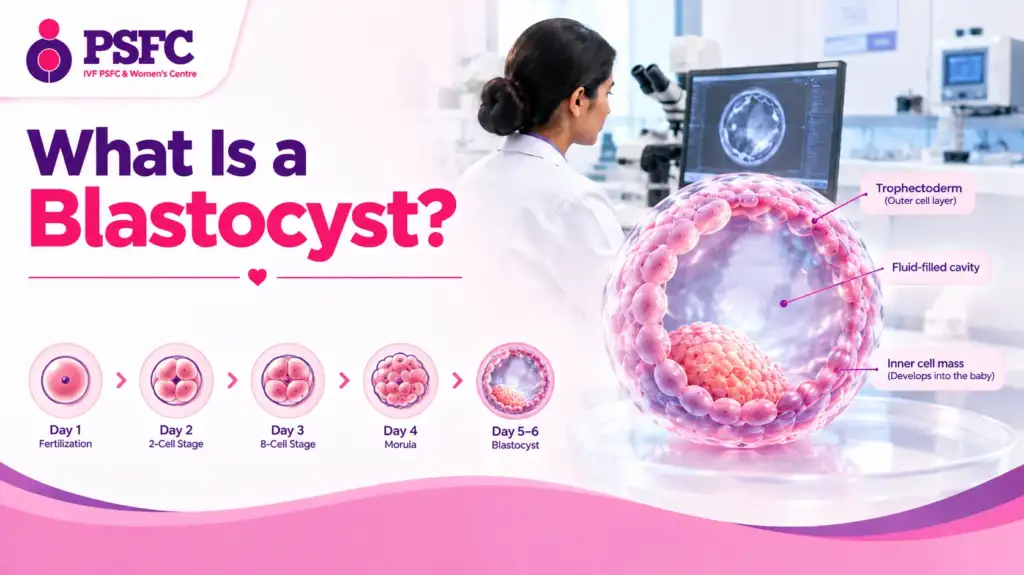
| A blastocyst is a Day 5 or Day 6 embryo. The inner cell mass becomes the baby and the outer layer (trophectoderm) becomes the placenta. Grades such as 4AA describe size and cell quality. A higher grade improves the odds but does not guarantee a pregnancy, and a lower grade does not rule one out. |
Medical review: Have this article medically reviewed and approved by Dr. Chitra Shankar MD (OG), MRCOG, DRM (Germany), FMAS, before publication.
Many think that implantation occurs after fertilisation, but in reality the embryo undergoes different stages before implanting. A blastocyst is a 5th or 6th day embryo with around 100 to 200 cells or more and has two cell types. The inner cell mass can develop into a baby, while the outer cell mass develops into the placenta.
Grading is important to determine the stage of blastocyst for IVF, and a high-grade blastocyst can improve the IVF success rates up to 70%. This guide provides an overview of blastocyst, its development, grading, risks, limitations and success rate in IVF.
What Is A Blastocyst?
A blastocyst is a multicelled developing embryo with a fluid-filled cavity that has the potential to implant into the inner wall of the uterus and form a baby. The structure of the balstocyst includes:
- Zona Pellucida: It is the outer protective layer covering the blastocyst.
- Inner cell mass (ICM): The group of cells in the cavity that can form into a baby.
- Trophectoderm (TE): It is the outer layer that hatches and implants into the womb.
- Blastocoel: This is the fluid-filled cavity inside the blastocyst.
Implantation: It is the process where the blastocyst attaches itself to the lining of the uterus.
Learn how IVF treatment works at PSFC
Blastocyst Formation
- The fertilised egg divides as it travels through the fallopian tube towards the uterus.
- The blastocyst forms in the fallopian tube.
- But in an IVF, the egg cells are collected, fertilised and directly implanted into the uterus after the blastocyst has formed.
The day-by-day growth of the blastocyst is given below:
| Day | Growth | What happens at this stage? |
| 0 | Fertlisation | ● Eggs are collected and injected with the sperm.
● If fertilisation occurs, a zygote will be formed |
| 1 | Zygote | ● The pronuclei confirm the success of the fertilisation. |
| 2 | Early cleavage (2-4 cells) | ● It is the early stage of division |
| 3 | Cleavage stage (6-8 cells) | ● Cell division proceeds |
| 4 | Morula | ● The cells might not be countable, as it forms a compact ball |
| 5 | Blastocyst | ● The cells are visible at this stage.
● The cells can be differentiated into an inner mass and an outer layer as fluid fills the central cavity. |
| 6 | Expanded blastocyst | ● The blastocyst expands, thinning the outer layer.
● The blastocyst will start hatching out of the zona pellucida and is ready for implantation |
Why Choose Blastocyst for IVF?
- Blastocyst increases the chances of implantation, and the blastocyst formation itself is a natural selection process.
- The abnormal embryos will not form into a blastocyst, and hence, the surviving ones are the strongest.
- The day 5 and 6 blastocysts are ready for implantation, when compared to the day 3 embryo.
Note: Every blastocyst cannot undergo implantation successfully.
Grading and Its Importance in IVF
Grading is the process of evaluating the structure and quality of the blastocyst.
Only the blastocyst with good quality will be selected, and the abnormal ones will be ruled out.
Expansion, inner cell mass quality and the trophectroderm quality are the factors that will be evaluated.
4AA, 5AA, 3AB, or 4AB are considered the best grades for the blastocyst selection.
Expansion
The grading is between 1 and 6, with higher numbers indicating greater expansion of the blastocyst.
| Grade | Stage |
| 1 | Early blastocyst |
| 2 | Developing blastocyst |
| 3 | Full blastocyst |
| 4 | Expanded blastocyst |
| 5 | Hatched blastocyst |
| 6 | Fully hatched blastocyst |
Inner Cell Mass
The quality of inner cell mass will be determined, and the grading is from A to C, where A is considered a high quality.
| Grade | Quality |
| A | Contains many tightly packed cells |
| B | Has loosely packed cells |
| C | Has only a few cells |
Trophectroderm
The quality of the trophectoderm will be evaluated based on the scale A to C, where A is considered a high-quality blastocyst.
| Grade | Quality |
| A | Contains many tightly packed cells |
| B | Has loosely packed cells |
| C | Has only a few cells |
Note: A good grade blastocyst does not mean that the IVF will be successful, and it does not guarantee a healthy baby. While a low-grade blastocyst can also make the IVF successful, the chances are unpredictable.
Types of Blastocyst Transfer
The blastocyst transfer is of two types: Fresh blastocyst transfer and frozen blastocyst transfer
Fresh Blastocyst Transfer
- The egg is retrieved and fertilised.
- The embryo is transferred to the uterus after 5-6 days at the blastocyst stage.
- This method is suitable for people with balanced hormonal levels and good endometrial health.
Frozen Blastocyst Transfer
- The blastocyst is frozen through a process called vitrification.
- The blastocyst will be thawed and then transferred to the uterus when needed.
- Suitable for people wanting to delay the pregnancy, have hormone fluctuations or have medical conditions like PCOS.
Day 3 vs Day 5 Embryo Transfer
- Day 3 embryo transfer involves transferring a 3-day-old embryo to the uterus, where there are 6 to 8 cells.
- Day 5 embryo transfer involves transferring an embryo at the blastocyst stage.
| Day 3 Embryo Transfer | Day 5 Embryo Transfer |
| The embryo is at the cleavage stage. | The embryo is at the blastocyst stage |
| Consists of around 6 to 8 cells | Contains around 200 cells |
| Difficulty in performing genetic testing | Genetic testing can be performed |
| Transferred at an earlier stage | Transferred after blastocyst forms |
| Suitable for patients with low embryo numbers | Suitable for patients with high embryo numbers |
New technology around blastocysts: time-lapse, AI and PGT-A
Time-lapse
- This can monitor the embryo development continuously.
- Cell division timing and morphological changes can be captured.
- Ensures the embryo is in stable condition.
AI
- AI scoring is used to select the normal embryo.
- Can increase the success rate of IVF.
Preimplantation Genetic Testing for Aneuploidies (PGT-A)
- It is a test for chromosomal anomalies.
- Lowers the miscarriage rates.
- Can benefit women with repeated pregnancy loss.
Factors Affecting Blastocyst Success Rate
The success rate of a blastocyst transfer is around 40 – 60%, depending on the age and other factors. The following are the factors that could affect blastocyst success rate:
- Age: The egg quality stays optimal for the women under the age of 35, and the quality of the eggs keeps decreasing with the increase in age.
- Medical conditions: Women with conditions like endometriosis, PCOS, blocked fallopian tubes, and other medical conditions can expect a lower success rate.
- Quality of egg and sperm: The good quality of the eggs and sperm can increase the success rates.
- Blastocyst quality: Good blastocyst grading improves the chances of implantation.
- Lifestyle: Diet, exercise, smoking, drinking and other habits can impact the quality of the egg.
Blastocyst Implantation: What Happens After the Transfer?
- The blastocyst stays in the uterus and implants after 1-5 days of the transfer.
- You can experience spotting, bloating, mild cramping and nausea during the first few days due to the medications and the procedure.
- Human chorionic gonadotrophin (hCG) will be produced on days 5-7 when the implantation is successful.
- The pregnancy can be confirmed through hormonal tests between the 9th and 12th days.
Common Symptoms After Blastocyst Transfer
The common symptoms after the blastocyst embryo transfer include:
- Mild cramping
- Spotting
- Fatigue
- Breast tenderness
- Bloating
- Nausea
- Frequent urination
Note: You may face no symptoms at all, which is common among many.
Post Treatment: Myths and Facts
| Myths | Facts |
| Need complete bed rest to recover | Complete bed rest is not required, but strenuous activities can be avoided |
| Implantation occurs immediately | Implantation requires 1 to 5 days to happen |
| IVF is a failure if there are no symptoms | It is normal for not experiencing symptoms |
| Certain foods can improve the chances of implantation | Implantation does not depend on the food |
| Once failed, then the process is completely a failure | The procedure can become a success in the upcoming cycles |
Care After the Blastocyst Transfer
- Do not miss any medications and take everything on time.
- Have healthy and balanced meals.
- Avoid doing strenuous activities like workouts and weightlifting.
- Avoid bathing with hot water.
- Avoid smoking and drinking alcohol.
- Take rest and do light exercises.
- Relax and relive your stress.
Medical Disclaimer: Consult your doctor before making any changes in diet or taking any medications by yourself.
Risks and Limitations of Blastocyst Transfer
- Not all embryos can reach the blastocyst stage, and you might end up having no embryo.
- Can be a risk for patients with low egg count or poor ovarian response.
- Need strict conditions and optimal conditions for the embryos to grow.
- The procedure cannot always guarantee success.
- All the clinics do not have blastocyst culture and may not have freezing facilities.
Who May Benefit From This Procedure
- Patients with high-quality embryos.
- Women having good uterine health.
- Women under 35 years of age can largely benefit, as they will be having good quality eggs.
- Patients requiring a single embryo to avoid twins.
- Patients who have previously failed a day 3 embryo transfer.
Blastocyst Transfer Cost in India
The total cost of blastocyst transfer, from embryo culture to transfer, can be around ₹150,000 – ₹350,000 or more per cycle.
The factors listed below can influence the costs:
- Hospital
- Surgeon
- Location
- Type of blastocyst transfer
- Diagnostic tests
- Scans
- Consultations
- Medications
- OT charges
- Egg retrieval
Can Blastocyst Reveal the Gender of the Baby
The genetic tests can reveal the gender of the baby, but they are performed solely to identify chromosomal abnormalities and avoid genetic disorders in newborns.
Note: The law in some countries, such as India, does not promote gender reveal before the baby is born, and it is strictly prohibited.
When to Contact a Doctor
Seek immediate medical care if you are facing any one of the below symptoms after a blastocyst transfer:
- Shortness of breath
- Dizziness
- Fever
- Abdominal swelling
- Severe abdominal pain
- Heavy bleeding
Key Takeaways
- Blastocyst is a 5- or 6-day embryo that has around 100 to 200 cells.
- Blastocyst is preferred over 3-day embryo transfer because it increases the chances of implantation.
- The grading will be performed to evaluate the quality of the blastocyst.
- The best grades for blastocyst are 4AA, 3AB, 5AA or 4AB.
- Fresh blastocyst transfer is performed a few days after egg retrieval.
- In the frozen blastocyst transfer, the blastocyst is frozen and thawed when required.
- Time-lapse, AI and PGT-A can be used to detect the embryo activity and embryo quality and improve success rate.
- Factors like age, medical conditions, egg quality and lifestyle can affect the blastocyst success rate.
- Mild cramping, spotting, fatigue, nausea, bloating and frequent urination are some of the symptoms after the blastocyst transfer.
Frequently Asked Questions
- When do I need a blastocyst transfer?
You will be recommended a blastocyst transfer if you have faced pregnancy loss previously or want to avoid twins.
- Is a blastocyst a baby?
A blastocyst is not a baby but an earlier stage of an embryo. The baby forms when the embryo develops into a foetus.
- How many days after blastocyst transfer can I take a pregnancy test?
You can take a pregnancy test between 9 and 14 days after the blastocyst transfer.
- Does a blastocyst increase the chance of twins?
A single blastocyst transfer does not increase the chances of twins, but there are chances for an embryo split in very rare cases. The chances of twins can increase when multiple blastocysts are transferred.
- Can poor quality blastocysts be transferred?
Yes, a poor-quality blastocyst can be transferred, but the chances of pregnancy will be low compared to the high-grade blastocysts.
